Let us start off today's bloggerisationisms, dear blog reader, with a round-up of some selected reviews from the media after the broadcast of The Snowmen on Christmas Day. The Independent's Neela Debnath wrote: 'The story was apparently based on a piece written by Douglas Adams. This may the reason why this year was decidedly more comic than previous Christmas specials. The humour is largely thanks to Strax who provided most of the laughs through his Sontaran view of the human race. But it was also more disturbing in a behind-the-sofa way, even at Christmas a little scare isn't always a bad thing. The Snowmen has now brought The Doctor out of his state of retirement and ready for action again after such a brooding period. While the episode was enjoyable the problem was that the story feels truncated and rushed. Granted the time frame leaves little room for dalliances but it would have been nice to have seen more of Simeon's developing relationship with the Great Intelligence. Grant is brilliant as the villain but more of him would have been even better.' Writing in the Radio Times, Patrick Mulkern noted: 'Hats off to Steven Moffat. He's just presented us with alternative abominable snowmen, and not only reintroduced the Great Intelligence but also established how this malignant, disembodied force came into being.  There are lots of lovely images (the Jack and the Beanstalk-like spiral staircase leading to the clouds), and my favourite moment being the truly wonderful effect of the camera (and hence the viewer) following The Doctor and Clara directly through the police box doors into the huge TARDIS interior. Has this effect ever been achieved before? I may have forgotten. And how was it done? Where's BBC3's Doctor Who Confidential when you need it!' The Daily Mirra's new TV review chap, Jon Cooper, added: 'Suddenly, The Doctor is faced with an intriguing new mystery – one that involves, among other things, soufflés. So where the kids will look forward to it and the fans will discuss it endlessly, maybe the casual watcher will be intrigued enough to follow the Time Lord into his golden year, just to see how the latest curious twist of the twice-dead girl unfolds. Where this year's Who "snowtacular" fails is appealing to the dinner-bloated and mildly disinterested middle viewer. It'll totally pass by family members who, at 5.15 in the afternoon, just want to sleep for a bit until they feel the need to attack the cold cuts. Through sprout-engorged eyes and a brandy befuddle, it's a great piece of entertainment but it doesn't hold up to much sober fanboy scrutiny. It's miles better than anything else on, but for the casual Christmas viewer there's little to hold the interest besides noticing how gorgeous the new companion is. And, maybe, the ending.' In the Torygraph, one Dominic Cavendish (no, me neither) felt: 'It was an enjoyable enough romp, I suppose, and I imagine that reference-spotters had a field-day. There were nods not only to The Snowman but also to Sherlock – cheekily suggested to have been, in "real-life", the lesbian Silurian Madame Vastra. The shadow of Henry James's The Turn of the Screw could be detected in the CGI figure of the dead governess, made of ice and snarling "That's The Way To Do It!" There were shades of Dickens and CS Lewis and maybe even the smoke-fashioned staircase from the Mary Poppins film too in the episode's best touch - having the newly refurbished TARDIS float above town on a bed of "super-dense water vapour", reachable only by a vertiginous spiral staircase.
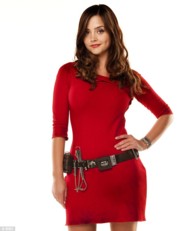
  Twinkly-eyed Matt Smith was on irrepressible form as always, his careworn Doc emerging from ethical hibernation to save the world, again, and exchange repartee with his adopted comedy sidekick Strax (Dan Starkey) of the once terrifying now just silly Sontaran race. The sooner his luscious new companion, revealed as Jenna-Louise Coleman's Clara – former barmaid and erstwhile Dalek – fills the Pond-shaped void in his life the better but I fear that if Moffat doesn't rein in his tendencies to make every script a brain-teaser of Sudoku-like complexity, his young audience will melt away, fast.' Ooo... get her. Dan Martin, the Gruniad Morning Star's review added: 'Welcome back, Merry Christmas, and wow. The Snowmen was easily the finest Christmas special under this regime. After last year's dog's giblets of an episode, it needed to be, but this poetic romp was actually the best since The Christmas Invasion, and possibly better. It had everything we like about Doctor Who (frights, romance, running, a menacing baddie, lizard people) while being just sentimental enough to tick off a lot of things we like about Christmas.' The episode also went down well across the, ahem, pond. The Los Angeles Times's Mary McNamara wrote: 'Clara appears to be a mirror image of The Doctor: fearless, curious and intuitive, a match not only of wits but of shared delight in the power of knowing. That is the perpetual tension that fuels The Doctor. A Time Lord weighted with the wisdom of the ages, believing himself to be the last of his kind, has only his sense of wonder to protect him from the great sorrow born of endless knowledge and experience. Fortunately it is boundless, like his energy, and of all the recent Doctors, Smith best captures the power of willful [sic] youthfulness. Not in appearance, though he is the most boyish of the canon, but in resilience, the springiness that allows a child to find miracles in the mundane, to truly believe that today will be better than yesterday. The world always needs The Doctor, but perhaps never more than on Christmas Day.' In the New York Magazine, Ross Ruediger said:
  'There can't be enough praise showered on Coleman at this point, who is quite simply a breath of fresh air for this series. I've not fallen for a new companion this hard and fast since Rose Tyler, who had the benefit of being there when the series relaunched, so that's not even a fair comparison. This new girl just devours the camera lens; a more photogenic companion we've probably never seen. It was easy to understand The Doctor's reinvigoration through her, because as viewers we were experiencing the same feelings, and the scene in which he gives her the TARDIS key, only for her to be lost seconds later, was a serious tearjerker; that was more moving than anything in The Angels Take Manhattan. I had mad, crazy love for both A Christmas Carol and The Doctor, The Widow & The Wardrobe, Moffat's previous holiday outings, and hoped to feel the same about The Snowmen, but ultimately didn't. Yet this episode held a much different function in the series than either of those entries, coming in the middle of a season as it did. Whereas his first two Christmas specials were entirely standalone tales, this one was anything but, steeped in the ongoing storyline as it was.' So, not a fan then? EntertainmentWise's Emma Gibbons added: 'So, there you have it - it was one intense episode full of adventure and tense scenes, but what would Doctor Who be without all of the chaos? In between such madness the Doctor and Clara even managed to find a moment to embrace in a loving/unexpected kiss and joke around with each other, including Doctor Who doing a one man version of Punch and Judy - what more could you ask for? It gave us all a brilliantly entertaining hour on our Christmas Day and I am sure it has left most of us wanting to know what happens next! We will just have to wait very patiently for later on into the year.' In the Western Australian, Michael Idato stated: 'All told The Snowmen is a strong Doctor Who episode. Jenna-Louise Coleman, who we first met as Oswin Oswald in Asylum of the Daleks, returns as Clara Oswald, presumably an ancestor. In true Moffat style, we finish the episode knowing a little more, and whole lot less, about her.'
Sherlock has been voted the top TV show of 2012 in a Radio Times poll of writers and critics. As, indeed, it was on this blog, by this blogger. So, you know, everyone's happy. Starring Benedict Cumberbatch and Martin Freeman, the BBC1 series beat the US EMMY and Golden Globe winning espionage thriller Homeland, shown on Channel Four, into second place. The Olympics comedy Twenty Twelve, the BBC2 mockumentary following a fictitious team behind the Games and starring Hugh Bonneville, Jessica Hynes and Olivia Colman, was voted third. Armando Iannucci's political satire The Thick of It, another BBC2 series, was placed fourth in the Top Ten. RadioTimes.com editor Tim Glanfield said: 'Sherlock delivered the TV event of the year with three perfect episodes. Nothing got people talking more than that cliffhanger series finale.' Fresh Meat, the utterly shite Channel Four alleged sitcom plotted around the lives of six students, claimed fifth position, followed by Borgen, the magnificent Danish political drama shown on BBC4 (number two in yer actual Keith Telly Topping's list). The Great British Bake Off was seventh, followed by Downton Abbey on ITV. The Scandinavian crime drama The Bridge, shown on BBC4, and Girls, a US comedy drama following the experiences of a group of twentysomething women, and broadcast on Sky Atlantic, were ninth and tenth respectively.
Some genuinely appalling news now, dear blog reader. Risible, odious, horrorshow (and drag) All Star Family Fortunes came out on top in a festive ratings battle against a Have I Got News For You clip show on Thursday night. The crappy Vernon Kay-hosted celebrity game show's annual Christmas special attracted 5.11m crushed victims of society to ITV between 7.30pm and 8.30pm. Meanwhile, a compilation edition of the BBC1 topical news quiz's latest series picked up 4.71m in the unusually early slot of 7.30pm to 8pm. At the same time, Dad's Army managed 2.14m and was BBC2's highest-rated broadcast of the night, showing that the classic sitcom remains a top draw for the channel. Between 9pm and 10.30pm, BBC1's two-part spy thriller Restless opened with a strong 5.62m, easily outperforming the completely rubbish Panto!, an - alleged - comedy-drama 'special' starring John Bishop which was watched by 2.65m on ITV. Elsewhere on BBC1, Pointless Celebrities was watched by 5.34m, the News At Six had a bumper audience of 6.46m, Celebrity Mastermind pulled in a creditable 4.47m and EastEnders topped the night with 7.77m. BBC2's night, post Dad's Army was anchored by Racing Legends (1.97m), followed by World's Most Dangerous Roads (1.92m) and Mock the Week (1.62m). ITV's two nightly episodes of Emmerdale were watched by 7.04m and 4.90m respectively. Overall in primetime, BBC1 had 24.4 per cent of the audience share, easily beating ITV's 16.5 per cent.
Yer actual Professor Brian Cox will examine the story of life through physics in a major new series for BBC2 - Wonders of Life - the trailer for which has just been revealed. Looks great.
ITV has been forced to release a statement in response to Downton Abbey fans' (probably media-created) 'outcry' over the death of the character of Matthew Crawley, as Dan Stevens admits that he felt the role was 'monopolising' his career. Some viewers were, reportedly, so upset by the character's death in the period drama's Christmas special that they felt it necessary to whinge to broadcaster ITV and 'demand an explanation.' Tragically, ITV's response was not to inform them that the 'explanation' is they have no frigging life and acquiring one should be their first priority. Pity, really. And, once again, let us simply marvel at the utter shit some people chose to care about. ITV, in fact, responded by explaining - very slowly - that Matthew had to leave the show as Dan Stevens had decided not to renew his contract, adding that it was felt given the strong bond between Crawley and Lady Mary a relationship split would not have been believable or acceptable to viewers. The statement reads: 'After three successful series and two Christmas editions of Downton Abbey, Dan Stevens decided not to renew his contract beyond the initial three years he had been contracted. We wish him every success for the future. Michelle Dockery will be returning to her role as Lady Mary in series four which begins production in February. Over the last three years, audiences across the world have been captivated by the ups and downs of Mary and Matthew's relationship, culminating in their wedding. Fans have enjoyed what has become a solid and loving marriage. It is for this reason that the producers decided Matthew and Mary could not simply be estranged or parted, resulting in his untimely and tragic death at the end of the Christmas episode. In the next series, alongside all the usual drama, comedy and romance involving the much loved cast of characters, viewers will see Mary adjusting to her life and attempting to move on without the man she loved.' Downton's festive episode saw Matthew die in a car crash as he sped home to share the news that Lady Mary had given birth to their son. The episode ended with Mary admiring the newborn, oblivious to her husband's grizzly and rather smashed-up fate. Clearing up exactly why he had decided to leave the popular show, Stevens - probably having just overtaken Jeremy Clarkson as the least popular man amongst whinging middle-class hippy 'give quiche a change'-style TV viewers at the moment - told the Daily Torygraph: 'We were always optioned for three years. And when that came up it was a very difficult decision. But it felt like a good time to take stock, to take a moment. From a personal point of view, I wanted a chance to do other things. It is a very monopolising job. So there is a strange sense of liberation at the same time as great sadness because I am very, very fond of the show and always will be.'
Holly Willoughby has 'revealed' that she 'almost' had her nose broken by Santa Claus. As if anybody actually gives a bloody Monkey's Arse about utter risible bollocks like that. Next ...
John Sullivan was reportedly working on an episode of Only Fools and Horses before his death. Although, if it was anywhere near as dreadful as Rock & Chips, it seems we all had one hell of a lucky escape. Sir David Jason has now revealed that Sullivan wanted to bring back the show for at least one more episode before his death in April last year. Sadly for Jason, he got lumbered with The Royal Bodyguard instead. With no hilarious consequences whatsoever. The actor stated that the episode would have revolved around Del Boy's sixty fifth birthday, and that he and the rest of the cast would have been 'interested' in a comeback. 'About four years ago, perhaps less, I got a message from John Sullivan and Gareth Gwenlan, who was the producer,' Jason told BBC Radio 4's The Media Show. 'John wanted to do another Christmas special with perhaps an episode or so afterwards. The idea of it was Del's sixty fifth birthday. That was his premise. There was nothing else said. He just wanted to know what I felt. Well, I know Sullivan. I know how he wrote. I just said, "John, you write it and I'll do it." I know all of the rest of the team couldn't wait to get back.' Well, of course they couldn't, none of them can get a decent job in TV these days. Jason added: 'Unfortunately things took a turn. I knew he was working on it, but it didn't come about.'
Tulisa Contostavlos wants to quit The X Factor, according to her dad. And, again, instead of carrying on with this load of rubbish, let's instead have some news that anyone actually gives a frig about.
 Alleged naughty old scallywag and rotten rotter Jimmy Savile 'gleefully' informed the prime minister about 'my girl patients' after meeting her at a Downing Street fundraising ceremony, where he sought advice on charities' tax deductions according to the Gruniad Morning Star. A letter preserved in Downing Street's records sheds fresh light on the extraordinary access the now-disgraced BBC presenter enjoyed at the height of his popularity. In the letter sent to Thatch during her first year in office, Savile 'displayed all his brazen charms' the Gruniad state.
  The note, featuring a prominent colour photo of himself, declared: 'Dear Prime Minister, I waited a week before writing to thank you for my lunch invitation because I had such a superb time I didn't want to be too effusive. My girl patients pretended to be madly jealous and wanted to know what you wore and what you ate. All the paralysed lads called me "Sir James" all week. They all love you. Me too!' Alleged dirty old, damn bad bugger and Tory (that last bit isn't alleged, it's a matter of public record), Saville signed the letter 'Jimmy Savile OBE' and included three kisses. Which would appear to be final and conclusive proof that Savile was, undoubtedly, sick in the head even if he wasn't any of the other things he's accused of being (a paedophile and a rapist amongst many others). A subsequent Downing Street note showed sensitivity only about 'the financial aspect' of government dealings with the former disc jockey. 'Jimmy Savile asked you about the length of time necessary for charitable covenants to qualify for tax relief,' a prime ministerial aide noted. 'The chancellor has already decided to reduce the time period for seven years to four years in next finance bill. We cannot even hint at this to Jimmy Savile at present.' Thatcher and Savile met quite often. The file records two further public engagements in early 1981. 'Jimmy Savile saw the prime minister this morning with the architect's plans for Stoke Mandeville hospital,' another report records. 'He suggested to her that as a "goodwill gesture" to all the members of the public who had contributed, the prime minister might be prepared to give a "government grant."'
  A letter from the Department of Health and Social Security suggested Thatcher should not spend 'NHS cash' but, rather, make a 'symbolic gesture; such as the donation of the first brick (if this was not too late).' In March 1981, Savile had lunch with Thatcher at Chequers – prompting anxious enquiries from her civil servants. 'Prime Minister: Can you kindly let me know if you made any promises to Jimmy Savile when he lunched with you yesterday, for instance: (i) Did you offer him any money for Stoke Mandeville? (ii) Did you tell him that you would appear on Jim'll Fix It?' Against the last question Thatcher scrawled in her trademark, dark felt pen: 'No.' In terms of the cash, she wrote: 'Promised to get govt [sic] contribution.' The government eventually donated five hundred thousand smackers to Stoke Mandeville. In a letter to Savile, dated 25 February 1980 and addressed 'Dear Jimmy,' Thatcher said: 'I am interested in the subject myself and I am now looking into it. Please leave it with me and I will write to you about it again within a few weeks. It is quite a complicated subject and I am sorry that I cannot give you any instant answer.' Further correspondence between the Inland Revenue and Number 10 includes a suggested letter Thatcher should write to Savile after the changes to charitable covenants were announced by the then-Chancellor Geoffrey Howe in his April 1980 Budget. While the Inland Revenue draft states the changes to tax relief had been examined 'a little time ago,' this is not mentioned in Thatcher's actual letter to Savile. The records show Thatcher and Savile met for 'a private lunch' on 8 March 1981 and, in a handwritten note to her private secretary at the time, she says she 'promised to get government contribution.' Asked by her officials what 'sum of money you envisaged,' in a handwritten note Mrs Thatcher says 'will discuss with PJ' - meaning Patrick Jenkin, then health and social security secretary.
  Jenkin was replaced as health secretary in the 1981 reshuffle by Norman Fowler. A note dated 30 December 1981, some eleven months after the initial approach from Savile, states: 'Mr Fowler has agreed to make available half a million to one million pounds for the Stoke Mandeville Appeal and he agrees you [Mrs Thatcher] should announce this tomorrow.' According to the documents, the government decided to make the money available as the International Year of Disabled People was drawing to a close and 'to show our interested in the disabled has not ended with the end of IYDP.' However, Old Fowlpest decided that the government would contribute half a million knicker as he wanted to donate a similar amount 'to other worthy causes' in the coming months. The letters released under the thirty-year rule date back to a time when Savile was best known for being a TV personality and charity fundraiser, whose efforts were rewarded with a knighthood in 1990. The exchanges may well be characteristic of a more innocent-minded era but some papers and sections of the file remain withheld from public scrutiny for another ten years, including the contents of a letter and a 'telephone message' from Savile to Downing Street on 5 February 1980.
The government considered pulling the home nations out of the football World Cup in 1982 during the Falklands War with Argentina, official papers released under the thirty year rule show. In government papers released by the National Archives, it was suggested some players felt 'revulsion' about potentially competing against Argentina. But Prime Minister Thatcher was warned that withdrawal would be a 'propaganda opportunity' for Argentina. England, Scotland and Northern Ireland did go to Spain for the tournament. Days after the Argentine invasion of the Falklands on 2 April 1982, a directive from sports minister Neil Macfarlane advised: 'I urge no sporting contact with Argentina at representative, club or individual level on British soil. This policy applies equally to all sporting fixtures in Argentina.' In a letter to Thatch the following month, Macfarlane reported growing doubts about the UK teams' attendance at the World Cup, starting in June. 'Up until a week or ten days ago I have taken the line that it was up to the Football Authorities to decide whether they should participate,' he wrote. 'However, the loss of British life on HMS Sheffield and Sea Harriers has had a marked effect on some international footballers and some administrators. They feel revulsion at the prospect of playing in the same tournament as Argentina at this time.' He added that FIFA, international football's governing body, had made it clear that Argentina would not be pressured to withdraw from the tournament and more than the British teams would be. 'In this case no other country would follow us in withdrawing from the World Cup,' Cabinet Secretary Robert Armstrong wrote to Thatch days later.
  'Argentina would see British withdrawal not as putting any pressure on them but as an opportunity to make propaganda: the United Kingdom, not Argentina, would be the country set apart.' Despite the discussions between the politicians, England, Scotland and Northern Ireland did all go on to compete in the tournament, although none of them met Argentina on the pitch. Scotland were - very amusingly - eliminated in the first group stage (remember Alan Hansen and Willie Miller running into each other and allowing Soviet player Ramaz Shengelia to score the goal that knocked them out? It was both thigh-slappingly funny and, if you will, unbelievable). England and Northern Ireland both qualified for the second round but were knocked out at that stage. Oh, Keegan and his comedy perm missing that header. Bad memories. Argentina exited the tournament after finishing bottom of their second round group which was won by eventual winners Italy. A filthy little cheat Diego Maradonna got sent off. Which was also funny. In August that year, after the end of the conflict, restrictions were lifted on sporting engagements with Argentina.
The new BBC wildlife series Africa will make it clear when animals have been filmed under 'controlled conditions' as opposed to in the wild. The move comes a year after an episode of Frozen Planet, featuring a polar bear with her cubs, was criticised ... although, admittedly it a criticised by several national newspapers with a clear - and quite sick - agenda smeared all over their ugly mush like shit and, therefore, not by anyone of consequence. Some shots in that programme, narrated by Sir David Attenborough, were filmed in a Dutch zoo, but - according to those with an agenda - 'many viewers' assumed footage came from the Arctic. Actually, no proof had ever been produced that 'many viewers' did assume this or anything even remotely like it but, that didn't stop the Gruniad Morning Star, the Daily Scum Mail, the Daily Mirra and various other louse-scum bastards from stirring up some trouble. Because, they're good at that. The producers of Africa said they felt it 'appropriate to be more explicit' about the origins of such sequences. Or, in other words, as with many people in the upper reaches of the BBC they're cowards and have no backbone when it comes to facing down crass and ignorant bullies. 'We feel it is important to maintain trust and credibility with the audience,' lied series producer James Honeyborne to the Radio Times. 'What's important to us is to be able to share great moments of animal nature and some controlled filming allows us to do that.' The BBC denied misleading Frozen Planet viewers in an episode broadcast on BBC1 in November 2011. It showed polar bear cubs shortly after birth in a den with their mother. The cubs were actually in a Dutch animal park, as revealed in behind-the-scenes footage which was shown on the show's website for all the world to see. It had been there for several weeks before those sick scum with an agenda tried to use this as 'proof' of deception. Because, they are scum. 'After Frozen Planet, research revealed audiences were interested in the variety of filming techniques but did not want to be misled in commentary,' a BBC spokesman said. 'This is why the BBC has decided to flag up a number of controlled sequences within the commentary.' And, not because they're scared the Scum Mail are going have a go at them. Oh no, perish the thought. Viewers will be able to go to the website after the programme has been on TV to see how scenes were filmed. Africa, also narrated by Sir David Attenborough, was filmed over four years. It explores the whole of the continent and features meerkats being outsmarted by birds, as well as battling giraffes.
Every Christmas, the charity Sense About Science records some of the silly scientific things alleged celebrities say and do in the hope that these high-profile figures might think twice, or seek advice, before making pseudoscientific claims to their legions of fans in the future. The 2012 list contains the usual rogues' gallery of misdeeds, such as Wee Shughie McFee, the sour-faced Scottish chef off Crossroads employing someone to 'heal' his home and sports stars deploying dubious treatments for healing injuries. But there is also, it seems, hope. 'The implausible and frankly dangerous claims about how to avoid cancer, improve skin or lose weight are becoming ever more ridiculous – and unfortunately they have a much higher profile than the research and evidence,' said Tracey Brown, SAS managing director. 'On the other hand, this year we have had more examples than ever sent to us of people in the public eye who clearly do check their facts, and we're pleased to have been able to help some of them this year.' On the roll call of the enlightened is the England cricketer Stuart Broad. Asked whether he took any dietary supplements by the Daily Scum Mail, he replied: 'I think you can get enough out of your diet without them. But when we travel to places like India and Bangladesh, we do take them.' Sian Porter, consultant dietitian and a British Dietetic Association spokesperson, welcomed the sensible words: 'Good on Stuart for realising that you can "do it with food" – a healthy balanced diet can provide all the nutrients you need. When touring Stuart may be unsure of the nutrition quality and variety of his food so may take a supplement during this time as an insurance policy.' Also praised was Gary Kemp, the former Spandau Ballet songwriter and actor, who said about alternative medicine: 'I've tried acupuncture, performed by my chiropractor, but I'm a pragmatic cynic and believe hardcore medicine and science should be your first port of call before you deviate to other things, otherwise your life could be at risk.' But bad celebrity ideas still abound, it would seem. Wee Shughie McFee, the sour-faced Scottish chef off Crossroads was listed in the 2011 list for injecting vitamins into his face. This year, Wee Shughie McFee, the sour-faced Scottish chef off Crossroads made the list when he told his Twitter followers, seemingly in all seriousness: 'Today I had someone heal my house. Strange but great,' followed by: 'The healer brings in good energy. Someone told me about it. It takes a couple of days.' The psychologist Professor Richard Wiseman had this message for Wee Shughie McFee, the sour-faced Scottish chef off Crossroads: 'There really isn't any evidence that anyone can "heal" your house, Wee Shughie McFee, the sour-faced Scottish chef off Crossroads. Normally house healers say a few prayers and occasionally explain how re-arranging things will help the energy flow through your property. This might make you feel less anxious and so feel better, but it's a lot of money to pay for a placebo and a bit of furniture shifting!' Also on the 'list of shame' are the Sheikh Yer Man City footballer Mario Balotelli, the tennis players Novak Djokovic and Serena Williams and the Olympic sprinter Dwain Chambers, who were all spotted wearing Kinesio coloured sports tape, which claims to help mend injuries. The sports scientist Greg Whyte said it was 'unclear' how the application of the tape could positively affect inflammation deep within the muscle. 'There is insufficient evidence to support its use over other more traditional treatments such as taping or strapping,' he said. 'That said, this tape could have added placebo effect. In sport, anything that enhances performance, whether real or imagined, has its place. Any additional benefits that enhance performance may be psychological and these could be profound.' The actor Goldie Hawn made the 2012 list thanks to her support for an education programme which aims to increase children's emotional wellbeing with lessons about the brain: 'Discovering the mechanics of the brain helps children understand where their emotions come from,' she is reported to have said. 'It effectively puts them in control of the way they respond to the outside world.' The neuroscientist Professor Sergio Della Sala responded that it could be 'interesting and fun' to know more about the functions of the brain but that this would not help children to 'understand their emotions' any more than understanding the chemical components of a ball would help them to kick it better. 'There are too many unsubstantiated recipes allegedly improving children's learning and wellbeing. But school is a serious matter and so meaning well, gut feelings, common sense, intuition or gurus' opinions are not the way. Show us the evidence.'
China has 'tightened' its rules on Internet usage to enforce a previous requirement that all users must fully identify themselves to service providers. The move is part of a package of measures which, the state-run Xinhua news agency claim, would 'protect personal information.' But, nobody with half-a-brain in their collective head believed that for a second. Critics believe the government is trying to limit freedom of speech. A bit like the Daily Scum Mail only, you know, more successfully. One hopes that From The North's four regular readers in China will still be able to read yer actual Keith Telly Topping's considered opinion that their government are a bunch of bastard fruitcake dictatorial chebs with a very small collective penis. Hence, their love of missiles as something of a dick compensator, one might suggest. There you go, nothing overtly controversial for the Standing Committee of the National People's Congress to get their knickers in a twist about. The announcement will be seen as 'evidence' China's new leadership is targeting the Interweb as a threat. In recent months, the Internet and social media have been used to orchestrate mass protests and a number of corrupt Communist Party officials have been exposed by individuals posting criticisms on the net. The Chinese authorities closely monitor Internet content which crosses its borders (hi, guys!) and regularly block allegedly 'sensitive' stories through use of what is known as the Great Firewall of China. However, it has not stopped hundreds of millions of Chinese using the Internet, many of them using micro-blogging sites to complain or campaign on issues of national interest, including government corruption.
The American soul singer, Fontella Bass, best remembered for the hit single 'Rescue Me', has died of complications following a heart attack. She was seventy two and had been in poor health for much of the past few years years. 'Rescue Me' reached the top of the US R&B chart in 1965 and is one of the best known soul songs. It has been covered by many artists. Fontella had a powerful voice and a background steeped in music. Her mother was gospel singer Martha Bass, one of The Clara Ward Singers and Fontella began performing at a young age, singing in her church's choir at the age of six. Like many of her generation, she graduated to soul and R&B in the 1960s, signing to Chicago's legendary Chess Records. She first found success in a duet with Bobby McClure on 'Don't Mess Up a Good Thing' and 'You'll Miss Me (When I'm Gone)'. She co-wrote 'Rescue Me' with Raynard Miner and Carl Smith, a song her daughter Neuka Mitchell said 'held a special place in her heart.' But it took years of legal battles for her to receive full royalty rights to the song. A final settlement was reached more than twenty years after the single was first released. Mitchell said her mother was 'an outgoing person. She had a very big personality. Any room she entered, she just lit the room up, whether she was on stage or just going out to eat.' Fontella Bass was married to the jazz trumpeter, Lester Bowie, who was her musical director. She died in St Louis, the city where she was born in 1940. After releasing the LP, Free, in 1972, Fontella effectively retired from music and concentrated on raising a family (she has four children with Bowie). She returned occasionally, being featured as a background vocalist on several recordings. In 1990 she recorded a gospel LP with her mother and her brother, the soul singer David Peaston, called Promises: A Family Portrait of Faith and undertook a tour of the US West Coast which featured both traditional gospel and blues performers. During the 1990s she hosted a short-lived Chicago radio talk show and released several gospel records on independent labels. Through old friend Hamiet Bluiett, she was invited to perform three song on the World Saxophone Quartet LP Breath of Life. The original version of 'Rescue Me' was utilised in a TV advertising campaign by American Express: Fontella stated that she was at a low point in her life when on New Year's Day 1990 she was astonished to hear her own voice singing 'Rescue Me' on the advert. The experience motivated her to make queries over the commercial use of her recording with the ultimate result a 1993 settlement with American Express and its advertising agency. She is survived by her four children.
So, for today's Keith Telly Topping's 45 of the Day, dear blog reader, sing it one more time, Fontella.

 There are lots of lovely images (the Jack and the Beanstalk-like spiral staircase leading to the clouds), and my favourite moment being the truly wonderful effect of the camera (and hence the viewer) following The Doctor and Clara directly through the police box doors into the huge TARDIS interior. Has this effect ever been achieved before? I may have forgotten. And how was it done? Where's BBC3's Doctor Who Confidential when you need it!' The Daily Mirra's new TV review chap, Jon Cooper, added: 'Suddenly, The Doctor is faced with an intriguing new mystery – one that involves, among other things, soufflés. So where the kids will look forward to it and the fans will discuss it endlessly, maybe the casual watcher will be intrigued enough to follow the Time Lord into his golden year, just to see how the latest curious twist of the twice-dead girl unfolds. Where this year's Who "snowtacular" fails is appealing to the dinner-bloated and mildly disinterested middle viewer. It'll totally pass by family members who, at 5.15 in the afternoon, just want to sleep for a bit until they feel the need to attack the cold cuts. Through sprout-engorged eyes and a brandy befuddle, it's a great piece of entertainment but it doesn't hold up to much sober fanboy scrutiny. It's miles better than anything else on, but for the casual Christmas viewer there's little to hold the interest besides noticing how gorgeous the new companion is. And, maybe, the ending.' In the Torygraph, one Dominic Cavendish (no, me neither) felt: 'It was an enjoyable enough romp, I suppose, and I imagine that reference-spotters had a field-day. There were nods not only to The Snowman but also to Sherlock – cheekily suggested to have been, in "real-life", the lesbian Silurian Madame Vastra. The shadow of Henry James's The Turn of the Screw could be detected in the CGI figure of the dead governess, made of ice and snarling "That's The Way To Do It!" There were shades of Dickens and CS Lewis and maybe even the smoke-fashioned staircase from the Mary Poppins film too in the episode's best touch - having the newly refurbished TARDIS float above town on a bed of "super-dense water vapour", reachable only by a vertiginous spiral staircase.
  Twinkly-eyed Matt Smith was on irrepressible form as always, his careworn Doc emerging from ethical hibernation to save the world, again, and exchange repartee with his adopted comedy sidekick Strax (Dan Starkey) of the once terrifying now just silly Sontaran race. The sooner his luscious new companion, revealed as Jenna-Louise Coleman's Clara – former barmaid and erstwhile Dalek – fills the Pond-shaped void in his life the better but I fear that if Moffat doesn't rein in his tendencies to make every script a brain-teaser of Sudoku-like complexity, his young audience will melt away, fast.' Ooo... get her. Dan Martin, the Gruniad Morning Star's review added: 'Welcome back, Merry Christmas, and wow. The Snowmen was easily the finest Christmas special under this regime. After last year's dog's giblets of an episode, it needed to be, but this poetic romp was actually the best since The Christmas Invasion, and possibly better. It had everything we like about Doctor Who (frights, romance, running, a menacing baddie, lizard people) while being just sentimental enough to tick off a lot of things we like about Christmas.' The episode also went down well across the, ahem, pond. The Los Angeles Times's Mary McNamara wrote: 'Clara appears to be a mirror image of The Doctor: fearless, curious and intuitive, a match not only of wits but of shared delight in the power of knowing. That is the perpetual tension that fuels The Doctor. A Time Lord weighted with the wisdom of the ages, believing himself to be the last of his kind, has only his sense of wonder to protect him from the great sorrow born of endless knowledge and experience. Fortunately it is boundless, like his energy, and of all the recent Doctors, Smith best captures the power of willful [sic] youthfulness. Not in appearance, though he is the most boyish of the canon, but in resilience, the springiness that allows a child to find miracles in the mundane, to truly believe that today will be better than yesterday. The world always needs The Doctor, but perhaps never more than on Christmas Day.' In the New York Magazine, Ross Ruediger said:
  'There can't be enough praise showered on Coleman at this point, who is quite simply a breath of fresh air for this series. I've not fallen for a new companion this hard and fast since Rose Tyler, who had the benefit of being there when the series relaunched, so that's not even a fair comparison. This new girl just devours the camera lens; a more photogenic companion we've probably never seen. It was easy to understand The Doctor's reinvigoration through her, because as viewers we were experiencing the same feelings, and the scene in which he gives her the TARDIS key, only for her to be lost seconds later, was a serious tearjerker; that was more moving than anything in The Angels Take Manhattan. I had mad, crazy love for both A Christmas Carol and The Doctor, The Widow & The Wardrobe, Moffat's previous holiday outings, and hoped to feel the same about The Snowmen, but ultimately didn't. Yet this episode held a much different function in the series than either of those entries, coming in the middle of a season as it did. Whereas his first two Christmas specials were entirely standalone tales, this one was anything but, steeped in the ongoing storyline as it was.' So, not a fan then? EntertainmentWise's Emma Gibbons added: 'So, there you have it - it was one intense episode full of adventure and tense scenes, but what would Doctor Who be without all of the chaos? In between such madness the Doctor and Clara even managed to find a moment to embrace in a loving/unexpected kiss and joke around with each other, including Doctor Who doing a one man version of Punch and Judy - what more could you ask for? It gave us all a brilliantly entertaining hour on our Christmas Day and I am sure it has left most of us wanting to know what happens next! We will just have to wait very patiently for later on into the year.' In the Western Australian, Michael Idato stated: 'All told The Snowmen is a strong Doctor Who episode. Jenna-Louise Coleman, who we first met as Oswin Oswald in Asylum of the Daleks, returns as Clara Oswald, presumably an ancestor. In true Moffat style, we finish the episode knowing a little more, and whole lot less, about her.'
Sherlock has been voted the top TV show of 2012 in a Radio Times poll of writers and critics. As, indeed, it was on this blog, by this blogger. So, you know, everyone's happy. Starring Benedict Cumberbatch and Martin Freeman, the BBC1 series beat the US EMMY and Golden Globe winning espionage thriller Homeland, shown on Channel Four, into second place.
 The Olympics comedy Twenty Twelve, the BBC2 mockumentary following a fictitious team behind the Games and starring Hugh Bonneville, Jessica Hynes and Olivia Colman, was voted third. Armando Iannucci's political satire The Thick of It, another BBC2 series, was placed fourth in the Top Ten. RadioTimes.com editor Tim Glanfield said: 'Sherlock delivered the TV event of the year with three perfect episodes. Nothing got people talking more than that cliffhanger series finale.' Fresh Meat, the utterly shite Channel Four alleged sitcom plotted around the lives of six students, claimed fifth position, followed by Borgen, the magnificent Danish political drama shown on BBC4 (number two in yer actual Keith Telly Topping's list). The Great British Bake Off was seventh, followed by Downton Abbey on ITV. The Scandinavian crime drama The Bridge, shown on BBC4, and Girls, a US comedy drama following the experiences of a group of twentysomething women, and broadcast on Sky Atlantic, were ninth and tenth respectively.
Some genuinely appalling news now, dear blog reader. Risible, odious, horrorshow (and drag) All Star Family Fortunes came out on top in a festive ratings battle against a Have I Got News For You clip show on Thursday night. The crappy Vernon Kay-hosted celebrity game show's annual Christmas special attracted 5.11m crushed victims of society to ITV between 7.30pm and 8.30pm. Meanwhile, a compilation edition of the BBC1 topical news quiz's latest series picked up 4.71m in the unusually early slot of 7.30pm to 8pm.
 At the same time, Dad's Army managed 2.14m and was BBC2's highest-rated broadcast of the night, showing that the classic sitcom remains a top draw for the channel. Between 9pm and 10.30pm, BBC1's two-part spy thriller Restless opened with a strong 5.62m, easily outperforming the completely rubbish Panto!, an - alleged - comedy-drama 'special' starring John Bishop which was watched by 2.65m on ITV. Elsewhere on BBC1, Pointless Celebrities was watched by 5.34m, the News At Six had a bumper audience of 6.46m, Celebrity Mastermind pulled in a creditable 4.47m and EastEnders topped the night with 7.77m. BBC2's night, post Dad's Army was anchored by Racing Legends (1.97m), followed by World's Most Dangerous Roads (1.92m) and Mock the Week (1.62m). ITV's two nightly episodes of Emmerdale were watched by 7.04m and 4.90m respectively. Overall in primetime, BBC1 had 24.4 per cent of the audience share, easily beating ITV's 16.5 per cent.
Yer actual Professor Brian Cox will examine the story of life through physics in a major new series for BBC2 - Wonders of Life - the trailer for which has just been revealed. Looks great.
ITV has been forced to release a statement in response to Downton Abbey fans' (probably media-created) 'outcry' over the death of the character of Matthew Crawley, as Dan Stevens admits that he felt the role was 'monopolising' his career. Some viewers were, reportedly, so upset by the character's death in the period drama's Christmas special that they felt it necessary to whinge to broadcaster ITV and 'demand an explanation.' Tragically, ITV's response was not to inform them that the 'explanation' is they have no frigging life and acquiring one should be their first priority. Pity, really. And, once again, let us simply marvel at the utter shit some people chose to care about. ITV, in fact, responded by explaining - very slowly - that Matthew had to leave the show as Dan Stevens had decided not to renew his contract, adding that it was felt given the strong bond between Crawley and Lady Mary a relationship split would not have been believable or acceptable to viewers. The statement reads: 'After three successful series and two Christmas editions of Downton Abbey, Dan Stevens decided not to renew his contract beyond the initial three years he had been contracted. We wish him every success for the future. Michelle Dockery will be returning to her role as Lady Mary in series four which begins production in February.
 Over the last three years, audiences across the world have been captivated by the ups and downs of Mary and Matthew's relationship, culminating in their wedding. Fans have enjoyed what has become a solid and loving marriage. It is for this reason that the producers decided Matthew and Mary could not simply be estranged or parted, resulting in his untimely and tragic death at the end of the Christmas episode. In the next series, alongside all the usual drama, comedy and romance involving the much loved cast of characters, viewers will see Mary adjusting to her life and attempting to move on without the man she loved.' Downton's festive episode saw Matthew die in a car crash as he sped home to share the news that Lady Mary had given birth to their son. The episode ended with Mary admiring the newborn, oblivious to her husband's grizzly and rather smashed-up fate. Clearing up exactly why he had decided to leave the popular show, Stevens - probably having just overtaken Jeremy Clarkson as the least popular man amongst whinging middle-class hippy 'give quiche a change'-style TV viewers at the moment - told the Daily Torygraph: 'We were always optioned for three years. And when that came up it was a very difficult decision. But it felt like a good time to take stock, to take a moment. From a personal point of view, I wanted a chance to do other things. It is a very monopolising job. So there is a strange sense of liberation at the same time as great sadness because I am very, very fond of the show and always will be.'
 Holly Willoughby has 'revealed' that she 'almost' had her nose broken by Santa Claus. As if anybody actually gives a bloody Monkey's Arse about utter risible bollocks like that. Next ...
John Sullivan was reportedly working on an episode of Only Fools and Horses before his death. Although, if it was anywhere near as dreadful as Rock & Chips, it seems we all had one hell of a lucky escape. Sir David Jason has now revealed that Sullivan wanted to bring back the show for at least one more episode before his death in April last year. Sadly for Jason, he got lumbered with The Royal Bodyguard instead. With no hilarious consequences whatsoever. The actor stated that the episode would have revolved around Del Boy's sixty fifth birthday, and that he and the rest of the cast would have been 'interested' in a comeback.
 'About four years ago, perhaps less, I got a message from John Sullivan and Gareth Gwenlan, who was the producer,' Jason told BBC Radio 4's The Media Show. 'John wanted to do another Christmas special with perhaps an episode or so afterwards. The idea of it was Del's sixty fifth birthday. That was his premise. There was nothing else said. He just wanted to know what I felt. Well, I know Sullivan. I know how he wrote. I just said, "John, you write it and I'll do it." I know all of the rest of the team couldn't wait to get back.' Well, of course they couldn't, none of them can get a decent job in TV these days. Jason added: 'Unfortunately things took a turn. I knew he was working on it, but it didn't come about.'
 Tulisa Contostavlos wants to quit The X Factor, according to her dad. And, again, instead of carrying on with this load of rubbish, let's instead have some news that anyone actually gives a frig about.

 The note, featuring a prominent colour photo of himself, declared: 'Dear Prime Minister, I waited a week before writing to thank you for my lunch invitation because I had such a superb time I didn't want to be too effusive. My girl patients pretended to be madly jealous and wanted to know what you wore and what you ate. All the paralysed lads called me "Sir James" all week. They all love you. Me too!' Alleged dirty old, damn bad bugger and Tory (that last bit isn't alleged, it's a matter of public record), Saville signed the letter 'Jimmy Savile OBE' and included three kisses. Which would appear to be final and conclusive proof that Savile was, undoubtedly, sick in the head even if he wasn't any of the other things he's accused of being (a paedophile and a rapist amongst many others). A subsequent Downing Street note showed sensitivity only about 'the financial aspect' of government dealings with the former disc jockey. 'Jimmy Savile asked you about the length of time necessary for charitable covenants to qualify for tax relief,' a prime ministerial aide noted. 'The chancellor has already decided to reduce the time period for seven years to four years in next finance bill. We cannot even hint at this to Jimmy Savile at present.' Thatcher and Savile met quite often. The file records two further public engagements in early 1981. 'Jimmy Savile saw the prime minister this morning with the architect's plans for Stoke Mandeville hospital,' another report records. 'He suggested to her that as a "goodwill gesture" to all the members of the public who had contributed, the prime minister might be prepared to give a "government grant."'
  A letter from the Department of Health and Social Security suggested Thatcher should not spend 'NHS cash' but, rather, make a 'symbolic gesture; such as the donation of the first brick (if this was not too late).' In March 1981, Savile had lunch with Thatcher at Chequers – prompting anxious enquiries from her civil servants. 'Prime Minister: Can you kindly let me know if you made any promises to Jimmy Savile when he lunched with you yesterday, for instance: (i) Did you offer him any money for Stoke Mandeville? (ii) Did you tell him that you would appear on Jim'll Fix It?' Against the last question Thatcher scrawled in her trademark, dark felt pen: 'No.' In terms of the cash, she wrote: 'Promised to get govt [sic] contribution.' The government eventually donated five hundred thousand smackers to Stoke Mandeville. In a letter to Savile, dated 25 February 1980 and addressed 'Dear Jimmy,' Thatcher said: 'I am interested in the subject myself and I am now looking into it. Please leave it with me and I will write to you about it again within a few weeks. It is quite a complicated subject and I am sorry that I cannot give you any instant answer.' Further correspondence between the Inland Revenue and Number 10 includes a suggested letter Thatcher should write to Savile after the changes to charitable covenants were announced by the then-Chancellor Geoffrey Howe in his April 1980 Budget. While the Inland Revenue draft states the changes to tax relief had been examined 'a little time ago,' this is not mentioned in Thatcher's actual letter to Savile. The records show Thatcher and Savile met for 'a private lunch' on 8 March 1981 and, in a handwritten note to her private secretary at the time, she says she 'promised to get government contribution.' Asked by her officials what 'sum of money you envisaged,' in a handwritten note Mrs Thatcher says 'will discuss with PJ' - meaning Patrick Jenkin, then health and social security secretary.
  Jenkin was replaced as health secretary in the 1981 reshuffle by Norman Fowler. A note dated 30 December 1981, some eleven months after the initial approach from Savile, states: 'Mr Fowler has agreed to make available half a million to one million pounds for the Stoke Mandeville Appeal and he agrees you [Mrs Thatcher] should announce this tomorrow.' According to the documents, the government decided to make the money available as the International Year of Disabled People was drawing to a close and 'to show our interested in the disabled has not ended with the end of IYDP.' However, Old Fowlpest decided that the government would contribute half a million knicker as he wanted to donate a similar amount 'to other worthy causes' in the coming months. The letters released under the thirty-year rule date back to a time when Savile was best known for being a TV personality and charity fundraiser, whose efforts were rewarded with a knighthood in 1990. The exchanges may well be characteristic of a more innocent-minded era but some papers and sections of the file remain withheld from public scrutiny for another ten years, including the contents of a letter and a 'telephone message' from Savile to Downing Street on 5 February 1980.
The government considered pulling the home nations out of the football World Cup in 1982 during the Falklands War with Argentina, official papers released under the thirty year rule show. In government papers released by the National Archives, it was suggested some players felt 'revulsion' about potentially competing against Argentina. But Prime Minister Thatcher was warned that withdrawal would be a 'propaganda opportunity' for Argentina. England, Scotland and Northern Ireland did go to Spain for the tournament.
 Days after the Argentine invasion of the Falklands on 2 April 1982, a directive from sports minister Neil Macfarlane advised: 'I urge no sporting contact with Argentina at representative, club or individual level on British soil. This policy applies equally to all sporting fixtures in Argentina.' In a letter to Thatch the following month, Macfarlane reported growing doubts about the UK teams' attendance at the World Cup, starting in June. 'Up until a week or ten days ago I have taken the line that it was up to the Football Authorities to decide whether they should participate,' he wrote. 'However, the loss of British life on HMS Sheffield and Sea Harriers has had a marked effect on some international footballers and some administrators. They feel revulsion at the prospect of playing in the same tournament as Argentina at this time.' He added that FIFA, international football's governing body, had made it clear that Argentina would not be pressured to withdraw from the tournament and more than the British teams would be. 'In this case no other country would follow us in withdrawing from the World Cup,' Cabinet Secretary Robert Armstrong wrote to Thatch days later.
  'Argentina would see British withdrawal not as putting any pressure on them but as an opportunity to make propaganda: the United Kingdom, not Argentina, would be the country set apart.' Despite the discussions between the politicians, England, Scotland and Northern Ireland did all go on to compete in the tournament, although none of them met Argentina on the pitch. Scotland were - very amusingly - eliminated in the first group stage (remember Alan Hansen and Willie Miller running into each other and allowing Soviet player Ramaz Shengelia to score the goal that knocked them out? It was both thigh-slappingly funny and, if you will, unbelievable). England and Northern Ireland both qualified for the second round but were knocked out at that stage. Oh, Keegan and his comedy perm missing that header. Bad memories. Argentina exited the tournament after finishing bottom of their second round group which was won by eventual winners Italy. A filthy little cheat Diego Maradonna got sent off. Which was also funny. In August that year, after the end of the conflict, restrictions were lifted on sporting engagements with Argentina.
 The new BBC wildlife series Africa will make it clear when animals have been filmed under 'controlled conditions' as opposed to in the wild. The move comes a year after an episode of Frozen Planet, featuring a polar bear with her cubs, was criticised ... although, admittedly it a criticised by several national newspapers with a clear - and quite sick - agenda smeared all over their ugly mush like shit and, therefore, not by anyone of consequence. Some shots in that programme, narrated by Sir David Attenborough, were filmed in a Dutch zoo, but - according to those with an agenda - 'many viewers' assumed footage came from the Arctic. Actually, no proof had ever been produced that 'many viewers' did assume this or anything even remotely like it but, that didn't stop the Gruniad Morning Star, the Daily Scum Mail, the Daily Mirra and various other louse-scum bastards from stirring up some trouble. Because, they're good at that. The producers of Africa said they felt it 'appropriate to be more explicit' about the origins of such sequences. Or, in other words, as with many people in the upper reaches of the BBC they're cowards and have no backbone when it comes to facing down crass and ignorant bullies. 'We feel it is important to maintain trust and credibility with the audience,' lied series producer James Honeyborne to the Radio Times. 'What's important to us is to be able to share great moments of animal nature and some controlled filming allows us to do that.'
 The BBC denied misleading Frozen Planet viewers in an episode broadcast on BBC1 in November 2011. It showed polar bear cubs shortly after birth in a den with their mother. The cubs were actually in a Dutch animal park, as revealed in behind-the-scenes footage which was shown on the show's website for all the world to see. It had been there for several weeks before those sick scum with an agenda tried to use this as 'proof' of deception. Because, they are scum. 'After Frozen Planet, research revealed audiences were interested in the variety of filming techniques but did not want to be misled in commentary,' a BBC spokesman said. 'This is why the BBC has decided to flag up a number of controlled sequences within the commentary.' And, not because they're scared the Scum Mail are going have a go at them. Oh no, perish the thought. Viewers will be able to go to the website after the programme has been on TV to see how scenes were filmed. Africa, also narrated by Sir David Attenborough, was filmed over four years. It explores the whole of the continent and features meerkats being outsmarted by birds, as well as battling giraffes.
Every Christmas, the charity Sense About Science records some of the silly scientific things alleged celebrities say and do in the hope that these high-profile figures might think twice, or seek advice, before making pseudoscientific claims to their legions of fans in the future. The 2012 list contains the usual rogues' gallery of misdeeds, such as Wee Shughie McFee, the sour-faced Scottish chef off Crossroads employing someone to 'heal' his home and sports stars deploying dubious treatments for healing injuries. But there is also, it seems, hope. 'The implausible and frankly dangerous claims about how to avoid cancer, improve skin or lose weight are becoming ever more ridiculous – and unfortunately they have a much higher profile than the research and evidence,' said Tracey Brown, SAS managing director. 'On the other hand, this year we have had more examples than ever sent to us of people in the public eye who clearly do check their facts, and we're pleased to have been able to help some of them this year.' On the roll call of the enlightened is the England cricketer Stuart Broad. Asked whether he took any dietary supplements by the Daily Scum Mail, he replied: 'I think you can get enough out of your diet without them. But when we travel to places like India and Bangladesh, we do take them.' Sian Porter, consultant dietitian and a British Dietetic Association spokesperson, welcomed the sensible words: 'Good on Stuart for realising that you can "do it with food" – a healthy balanced diet can provide all the nutrients you need. When touring Stuart may be unsure of the nutrition quality and variety of his food so may take a supplement during this time as an insurance policy.' Also praised was Gary Kemp, the former Spandau Ballet songwriter and actor, who said about alternative medicine: 'I've tried acupuncture, performed by my chiropractor, but I'm a pragmatic cynic and believe hardcore medicine and science should be your first port of call before you deviate to other things, otherwise your life could be at risk.' But bad celebrity ideas still abound, it would seem. Wee Shughie McFee, the sour-faced Scottish chef off Crossroads was listed in the 2011 list for injecting vitamins into his face. This year, Wee Shughie McFee, the sour-faced Scottish chef off Crossroads made the list when he told his Twitter followers, seemingly in all seriousness: 'Today I had someone heal my house. Strange but great,' followed by: 'The healer brings in good energy. Someone told me about it. It takes a couple of days.' The psychologist Professor Richard Wiseman had this message for Wee Shughie McFee, the sour-faced Scottish chef off Crossroads: 'There really isn't any evidence that anyone can "heal" your house, Wee Shughie McFee, the sour-faced Scottish chef off Crossroads. Normally house healers say a few prayers and occasionally explain how re-arranging things will help the energy flow through your property. This might make you feel less anxious and so feel better, but it's a lot of money to pay for a placebo and a bit of furniture shifting!'
 Also on the 'list of shame' are the Sheikh Yer Man City footballer Mario Balotelli, the tennis players Novak Djokovic and Serena Williams and the Olympic sprinter Dwain Chambers, who were all spotted wearing Kinesio coloured sports tape, which claims to help mend injuries. The sports scientist Greg Whyte said it was 'unclear' how the application of the tape could positively affect inflammation deep within the muscle. 'There is insufficient evidence to support its use over other more traditional treatments such as taping or strapping,' he said. 'That said, this tape could have added placebo effect. In sport, anything that enhances performance, whether real or imagined, has its place. Any additional benefits that enhance performance may be psychological and these could be profound.' The actor Goldie Hawn made the 2012 list thanks to her support for an education programme which aims to increase children's emotional wellbeing with lessons about the brain: 'Discovering the mechanics of the brain helps children understand where their emotions come from,' she is reported to have said. 'It effectively puts them in control of the way they respond to the outside world.' The neuroscientist Professor Sergio Della Sala responded that it could be 'interesting and fun' to know more about the functions of the brain but that this would not help children to 'understand their emotions' any more than understanding the chemical components of a ball would help them to kick it better. 'There are too many unsubstantiated recipes allegedly improving children's learning and wellbeing. But school is a serious matter and so meaning well, gut feelings, common sense, intuition or gurus' opinions are not the way. Show us the evidence.'
China has 'tightened' its rules on Internet usage to enforce a previous requirement that all users must fully identify themselves to service providers. The move is part of a package of measures which, the state-run Xinhua news agency claim, would 'protect personal information.' But, nobody with half-a-brain in their collective head believed that for a second. Critics believe the government is trying to limit freedom of speech.
 A bit like the Daily Scum Mail only, you know, more successfully. One hopes that From The North's four regular readers in China will still be able to read yer actual Keith Telly Topping's considered opinion that their government are a bunch of bastard fruitcake dictatorial chebs with a very small collective penis. Hence, their love of missiles as something of a dick compensator, one might suggest. There you go, nothing overtly controversial for the Standing Committee of the National People's Congress to get their knickers in a twist about. The announcement will be seen as 'evidence' China's new leadership is targeting the Interweb as a threat. In recent months, the Internet and social media have been used to orchestrate mass protests and a number of corrupt Communist Party officials have been exposed by individuals posting criticisms on the net. The Chinese authorities closely monitor Internet content which crosses its borders (hi, guys!) and regularly block allegedly 'sensitive' stories through use of what is known as the Great Firewall of China. However, it has not stopped hundreds of millions of Chinese using the Internet, many of them using micro-blogging sites to complain or campaign on issues of national interest, including government corruption.
The American soul singer, Fontella Bass, best remembered for the hit single 'Rescue Me', has died of complications following a heart attack. She was seventy two and had been in poor health for much of the past few years years. 'Rescue Me' reached the top of the US R&B chart in 1965 and is one of the best known soul songs. It has been covered by many artists. Fontella had a powerful voice and a background steeped in music. Her mother was gospel singer Martha Bass, one of The Clara Ward Singers and Fontella began performing at a young age, singing in her church's choir at the age of six. Like many of her generation, she graduated to soul and R&B in the 1960s, signing to Chicago's legendary Chess Records. She first found success in a duet with Bobby McClure on 'Don't Mess Up a Good Thing' and 'You'll Miss Me (When I'm Gone)'. She co-wrote 'Rescue Me' with Raynard Miner and Carl Smith, a song her daughter Neuka Mitchell said 'held a special place in her heart.' But it took years of legal battles for her to receive full royalty rights to the song. A final settlement was reached more than twenty years after the single was first released. Mitchell said her mother was 'an outgoing person. She had a very big personality.
 Any room she entered, she just lit the room up, whether she was on stage or just going out to eat.' Fontella Bass was married to the jazz trumpeter, Lester Bowie, who was her musical director. She died in St Louis, the city where she was born in 1940. After releasing the LP, Free, in 1972, Fontella effectively retired from music and concentrated on raising a family (she has four children with Bowie). She returned occasionally, being featured as a background vocalist on several recordings. In 1990 she recorded a gospel LP with her mother and her brother, the soul singer David Peaston, called Promises: A Family Portrait of Faith and undertook a tour of the US West Coast which featured both traditional gospel and blues performers. During the 1990s she hosted a short-lived Chicago radio talk show and released several gospel records on independent labels. Through old friend Hamiet Bluiett, she was invited to perform three song on the World Saxophone Quartet LP Breath of Life. The original version of 'Rescue Me' was utilised in a TV advertising campaign by American Express: Fontella stated that she was at a low point in her life when on New Year's Day 1990 she was astonished to hear her own voice singing 'Rescue Me' on the advert. The experience motivated her to make queries over the commercial use of her recording with the ultimate result a 1993 settlement with American Express and its advertising agency. She is survived by her four children.
 So, for today's Keith Telly Topping's 45 of the Day, dear blog reader, sing it one more time, Fontella.


