Sunday, January 10, 2021

Anarchy In The USA

So, dear blog reader, as two of the great philosophers of this modern age once, so wisely, noted 'shit just got real'.
'We've been asked to speak politics to you today-ah.' Welcome you are to part, the first (and, probably, last) of a brand spankin' new From The North feature. Don't all cheer at once, please.
This blogger knows that The Village People were desperate to launch their ersatz comeback with some kind of major media event. But this was surely neither the time nor, indeed, the place for such 'YMCA'-style shenanigans, dear blog reader. (This blogger's thanks go to his good mate Christian for that particular joke.)
Okay, taking a far more serious tone at this juncture; it is a much-used cliché that a week - any week - is 'a long time in politics.' But some weeks are, clearly, longer - and stranger - than others. A case in point: This week began with a perfectly extraordinary story that, in any other week, would have dominated every news cycle for the full seven days and probably well beyond but which, given the events of the following days, almost seems to have been forgotten by many. It was the release of a leaked audio recording of a telephone call in which the soon-to-be-former President of the United States of America appeared to pressurise the Secretary of State for Georgia, Brad Raffensperger, to falsify the results of November's erection in his, the soon-to-be-former President's, favour. Something that the Secretary of State for Georgia - to his immense credit and showing more spine than the rest of his party put together - flatly refused to do. As noted, in any normal week that would have been the only story in town. But, it was merely the hors d'oeuvre for that which followed. The next day, in a scene that - in a galaxy far, far, away - saw Ewoks dancing, the soon-to-be-former President's party, the Republicans (you remember them?), lost control of the Senete. As, in no small part thanks to the soon-to-be-former President's sulky and very public attempts to make everything about him, voters in Georgia's run-off erection rejected both incumbents (a pair of dodgy hypocritical soon-to-be-former President Mister Rump arse-licking gangsters whom the soon-to-be-former President doesn't appear to think much of). And voted, instead, for a pair of Democrats, Jon Ossoff and Raphael Warnock.
That was followed by a day in which the US Congress officially certified the results of November's Presidential erection. But, only after the session had to be suspended when the Capitol building was attacked by a mob of crazed right-wing seditious rioting scum. Who had, seemingly, been actively encouraged in their violent insurrectionist endeavours and nefarious domestic terrorism by the soon-to-be-former President - and several of his lickerty-split acolytes, some of them shamelessly unapologetic - at a rally outside The White House. To sum up, then, it was only Wednesday and we had already seen an attempted (but, ultimately failed) coup d'état taking place in the world's largest superpower. As this blogger said, some week's are longer - and stranger - than others.
There is, currently - and rightly - a lot of discussion occurring about any potential ramifications (legal and otherwise) following the truly shocking, disturbing, sickening and, ultimately, deadly events which took place on Wednesday in Washington DC. Events which anyone with half-a-brain in their heads has had a pretty fair idea was coming for the last two months at least.
About whether Congress could, should or would vote to impeach, soon-to-be-former President Mister Rump. For general abuse of power, inciting a riot, fermenting seditious assembly, seeking to defraud the public, being orange in public in an untoward manner, et cetera. It appears, at the time of writing, as though Congress intends to, at the very least, give it a go early next week. But, questions remain - whether such a course of action is worthwhile. Whether, given the timescale before soon-to-be-former President Mister Rump leaves The White House, it would be merely a symbolic act or an empty gesture of disapproval. One which history will, of course, record but which would, ultimately, have little or no lasting effect. Whether, indeed, it has the potential to be perceived - by those with a sick agenda - as a partisan political act; one which could, ultimately, prove to be counter-effective. In so much as it may provide die-hard supporters of soon-to-be-former President Mister Rump with an aura of being, yet again, the innocent, oppressed victim of political opponents. This blogger offers no personal views on these matters - not being an American citizen, as a consequence, this blogger can only ever provide an outsider's perspective on what is purely an internal affair. That said, this blogger would like to offer you all one observation.
And it's this; had similar events taken place virtually anywhere else in the world, had a Head of State in many other countries seemingly engaged in a conspiracy to incite a crowd of his (or her) supporters to seditious, violent actions to prevent his (or her) political opponents from doing their job then what would have happened? Well, had such an incident occurred in a country in, let's say Central America, or South America, or Africa, or certain parts of Europe, or most of the Middle East or some parts of the Far East then the answer is very simply - nothing whatsoever would have happened (except that, in all likelihood, the death toll in such an incident would have been greater than five). The reason? Many of those places are dictatorships and the Head of State can, effectively, do whatsoever the Hell he (or she) likes without fear of comeback. But, what do you do with a Head of State in a country where he (or she) - in theory, at least - can't do whatever the Hell he (or she) likes without fear of some repercussions? Do you simply run down the clock on their time in office and then celebrate when they've gone away? Or, do you take some action before that occurs - however weak or pointless it may appear to be? This blogger will leave that question hanging, dear blog reader, like a sock on a radiator for you all to ponder.
The main arbiter in all this is probably that to do nothing is - tacitly - to say that you approve of soon-to-be-former President Mister Rump's crass, sinister and insidious actions. The other, potential, supporting factor about the threat of an impeachment vote is that it would, once and for all, force all Republican Congresspersons and, if it gets a majority in Congress (which it almost certainly would) and then Senators to actually go on the record and demonstrate - for posterity - whether they (tacitly) approve of what went down in their place of employment on Wednesday. Or not. Again, this is possibly an empty gesture but it is one that may, perhaps, be worth the effort. Time will tell. It usually does.
There is, as it happens, at least one previous precedent for an impeachment continuing after the impeachee has left office (one of President Grant's cabinet, was apparently impeached after he had already resigned). This blogger got that particular nugget of information from the BBC's Americast podcast's US political expert, the very excellent Anthony Zucker. By the way, dear blog reader, if you're not all listening to Americast already, then you really should be. This blogger thinks it's great.
The one major effect that such a judicial scenario would have is that it would, if ultimately successful, prevent soon-to-be-former President Mister Rump from ever running for an elected office again (not even The City Dogcatcher in Boise, Idaho). Which, some people may consider has some merit to it. Again, this blogger offers no opinion on that score whatsoever. Oh no, very hot water.
Anyway, dear blog reader, that's the end of the serious bit. This, meanwhile, was funny. CNN's Wolf Blitzer on Wednesday condemned the mob storming the Capitol, with the observation that the raggle-taggle army of misfits and clowns supporting soon-to-be-former President Mister Rump's lame efforts to overturn the erection results are 'probably are too stupid to know that they're heading for jail.' Yep, that sounds about right, Wolf.
Take this chap, for instance. His story was also thigh slappingly hilarious. A tip, 'Bigo', mate: If you are intending to commit a federal crime, or a series of them (trespass, breaking and entering, theft and, last but by no means least, treason) it's probably not a good idea to get yourself interviewed by the New York Times and a couple of national broadcasters on your way out of the building. And, to give them your full name, address and occupation (which appears to be Certified Moron).
And, so was this headbanger's story. Again, if you're in the process of stealing something, as a general rule you probably want to avoid waving to the cameras whilst you are fleeing the scene. You grinning cretin.
The very great Stephen Colbert ripping 'Elizabeth from Knoxville, Tennessee' a new asshole on Thursday's The Late Show was also well-worth a few moments of your time, dear blog reader. Though, there are widespread claims - as yet unproven - that 'Elizabeth from Knoxville' is, actually, from Maryland.
Soon-to-be-former President Mister Rump did, eventually (and seemingly reluctantly), acknowledge his defeat in a video and urged his supporters for a perod of political reconciliation in what was, perhaps, as close as we will ever get to an actual concession. Close, but not quite close enough. Indeed, many commentators suggested that he had only been prompted to do so by those surrounding him - 'the adults in the room' as they like to be known - who realised that, if he hadn't done something to calm the situation, there was a genuine risk of the soon-to-be-former Vice-President (with whom the soon-to-be-former President is, allegedly, not currently on speaking terms) invoking the Twenty Fifth Amendment. And, thus removing soon-to-be-former President Mister Rump's sorry ass from office and kicking him into the gutter on Pennsylvania Avenue along with all the other turds. Predictably, this marginally-more-contrite-than-normal (if, somewhat unbelievable) statement went down like a fart in a spacesuit with soon-to-be-former President Mister Rump's 'army' of insurrectionists, domestic terrorists and louse scum. To say that his online faithful did not take his sudden about-face (and his, effectively, throwing all of them under the bus in the process) too kindly would be putting it mildly. See, for example, Politico's report 'Coward': MAGA Internet Turns On Trump. Or, the Gruniad Morning Star's Donald Trump Fans Cry Betrayal As He Rebukes Capitol Violence. Hell, it would appear, hath no fury like a group of right-wing numbskulls given a jolly harsh lesson in political chicanery and back-covering. And, the soon-to-be-former President couldn't even defend himself as Twitter had just made him the first world leader in history to have his account banned. Needless to say, soon-to-be-former President Mister Rump was not too chuffed about being publicly muzzled in such a way. Pure dead pissed off, so he was. That, dear blog reader, was funny.
According to FAUX News, one knock-on effect of soon-to-be-former President Mister Rump's various Interweb platform bans is that now the dude can't even access Spotify. Which seems a bit harsh even if he did attempt to ferment a gloriously-inept failed coup. How is he going to listen to some bangin' tunes from his supporters like Lil Wayne and Ted Nugent now? Perhaps we'll never care.
So, for soon-to-be-former President Mister Rump, yer actual Keith Telly Topping thought it would be a nice thing to do to, helpfully, put together a playlist of appropriate tunes especially for him which he can listen to whilst he's offline. This one. This one. And, this one. And this one. And this one. And this one. And this one. And this one. And this one. And, of course, most importantly, this one. Hey, what can this blogger say Keith Telly Topping is a thoughtful guy ...
Another moment of supreme irony in this whole, sorry, affair was reflected in a piece in the Independent, Trump Rioters Could Face Long Jail Terms Because Of His Executive Order To Punish Black Lives Matter. Whether 'Bigo', 'Elizabeth from Knoxville', Jake 'The QAnon Shaman' (who, apparently, is an unemployed 'failed actor' who currently lives with his mom), Derrick the - now-extremely-former - West Virginia lawmaker and all the rest of the screaming mob will, as one article claims, end up facing twenty years in The Joint for their naughty terroristic ways is unknown. 'Could' being a frighteningly imprecise word when it comes to criminality. In other - less horrific - circumstances, such a turn of events might have been considered utterly hilarious. But people are dead, dear blog reader. Frankly, this whole situation passed 'funny' a long, long way back down the road.
Right, that's the politics over and done with. We now return you to our normal From The North programming ... of gushing TV reviews, jokes about amusingly convoluted or daft headlines and despair about how chronically awfully this blogger's favourite football team is currently being run. Plus ça change, plus c'est la même chose. It's what From The North is here for.
This blogger really enjoyed the Star Trek: Discovery series finale broadcast earlier this week (yer actual proper Star Trek, that was). Then, this blogger read half-a-dozen whingy-faced online reviews from people telling this blogger (and everyone else who had enjoyed it) that they was wrong - bigly wrong with terminal potential, at that - for such nincompoop malarkey. So, that's this blogger told right good and proper for even daring to think about being enthusiastic about something. Do you ever have one of those days, dear blog reader, where you just hate the world and pretty much everyone in it?
From that, dear blog reader, to this ...
Spiral. And, of course, the Gruniad Morning Star loves it too ...
Qi. Albeit, this week's episode was, by a distance, the worst in living memory in this blogger's opinion. Not helped by the inclusion both Tom Allen (whom this blogger considers to1 be about as a funny as Keith Telly Topping's arsehole) and Ed Gamble (whom this blogger considers to be about as funny as Tom Allen's arsehole). Even the presence of the utterly brilliant Maggie Aderin-Pocock couldn't quite save the episode from descending into a sludge of turgidness and sniggering crudeness. A great pity.
The From The North Headline of The Week award goes to Nigel Farage's Brexit Party Officially Changes Its Name. To 'The Party With Nothing To Run On Party', no doubt.
Closely followed by the Gruniad Morning Star's HG Wells Fans Spot Numerous Errors On Royal Mint's New Two Pound Coin. The Four-Legged Tripod was, this blogger thought, a particularly nice touch.
All of which, once again, proved an age-old From The North truism, dear blog reader.
Let us also have a big round of applause for this week's best 'stupid criminals' news story. Well, this week's best 'stupid criminals' news story which didn't involve an attempted terrorist insurrection of a major superpower, obviously. 'World's Unluckiest Burglars' Arrested After Calling Police By Accident. That's not unlucky, guys, that's just lain stupid.
The acclaimed TV and movie director Michael Apted has died at the age of seventy nine. The film-maker and documentarian was known for films such as Gorillas In The Mist and Coal Miner's Daughter, as well as his long-running series of Up documentaries. Apted's career started in the 1960s on the small screen and in 1964, he assisted on Seven Up! part of Granada's current affairs strand World In Action. He helped the director, Paul Almond, interview fourteen seven-year-old children about how they saw the world and then continued to independently revisit them every seven years over the course of their lives. The most recent revisitation, Sixty Three Up, was broadcast in 2019 and the director referred to it as 'the most important thing I have ever done.' The series as a whole won The Peabody Award in 2012. 'The series was an attempt to do a long-view of English society,' Apted said in an interview last year. 'The class system needed a kick up the backside.' In promotion for the most recent instalment, Apted expressed a desire to continue in another seven years' time, saying he would continue as long as he 'can breathe and speak.' Apted was born in 1941 in Aylesbury, the son of Frances Amelia and Ronald William Apted. His father worked for an insurance company. Apted attended the City of London School and then studied law and history at Downing College, Cambridge. During his seven-year period of working at Granada, Apted also directed a number of episodes of Coronation Street, written by Jack Rosenthal among others. Apted and Rosenthal later collaborated on a number of popular television projects, including the pilot episodes for The Dustbinmen and The Lovers. They worked together again in 1982 for the TV movie P'tang, Yang, Kipperbang, the first film commissioned by Channel Four. In 1976 Apted directed a play in the Granada series Laurence Olivier Presents, an adaptation of Harold Pinter's The Collection with Olivier, Malcolm McDowell, Alan Bates and Helen Mirren. His other TV work included Haunted (1967), Big Breadwinner Hog (1969), Parkin's Patch (1969 to 1970), Rosenthal's award-winning Another Sunday and Sweet FA (1970), Follyfoot (1971) and the BBC's Play For Today for whom he directed six plays between 1972 and 1977. These including Stronger Than The Sun, written by Stephen Poliakoff and starring Francesca Annis as a young woman who places her life in danger to expose a crime, a theme which Apted returned to several times. In the 1970s, Apted made his big-screen debut, directing the Second World War drama The Triple Echo, starring Oliver Reed and Glenda Jackson. He was behind the camera on 1974's Stardust which continued the story, begun in Claude Whatham's That'll Be The Day, of the John Lennon-like rock star Jim MacLaine, played by David Essex. The director also made the gritty crime drama The Squeeze in 1977, starring Stacy Keach as an alcoholic ex-detective who tries to pull his life together when his wife and daughter are kidnapped. David Hemmings and Edward Fox had the opportunity to play against type in unsavoury roles and Stephen Boyd played an Irish crime lord, brilliantly, in his last film role. In 1979 Apted made Agatha, his first movie produced by a Hollywood studio (Warner Bros), starring Vanessa Redgrave, Dustin Hoffman and Timothy Dalton in the speculative story of Agatha Christie's 1926 disappearance. He saw his first major film success in 1980 with Coal Miner's Daughter, the Loretta Lynn biopic starring Sissy Spacek. It was nominated for seven Oscars, winning Spacek the best actress award. Apted went on to direct Sigourney Weaver in Gorillas In The Mist, a film which also picked up five Oscar nominations, Nell, with Jodie Foster, the Kate Winslet Bletchley Park drama Enigma, the Jennifer Lopez thriller Enough and, most recently, the action film Unlocked starring Noomi Rapace. 'What I like about women at the centre of films is that I find that a woman character brings a lot of emotion to a story, whatever a story is,' he said in a 2017 interview. 'Whether it's a woman with gorillas or a country music singer, a woman's emotional life - at least on the surface - is more dramatic than a man's.' Gorky Park (1983) was an atmospheric mystery drama based on the novel by Martin Cruz Smith, starring William Hurt, Lee Marvin and Brian Dennehy. He also directed the 1999 James Bond adventure The World Is Not Enough - with Piers Brosnan and featuring one of the worst performances in the history of movies from Denise Richards - and the fantasy sequel The Chronicles Of Narnia: The Voyage Of The Dawn Treader. In addition to movies, Apted continued directing documentaries, including Bring On The Night, a feature-length concert film about the making of Sting's first solo LP. But, we shouldn't regard him too harshly for that fiasco. In 1997, he explored the creative process in Inspirations through candid discussion with seven artists from diverse media, including David Bowie, Louise Lecavalier and Roy Lichtenstein among others. Apted is survived by his third wife, Paige Simpson, sons Jim and John and daughter Lily Mellis all from previous relationships. He was predeceased by another son, Paul.

Tuesday, January 05, 2021

Heat Not A Furnace For Your Foe So Hot That It Do Singe Yourself

We begin the latest bloggerisationisms update, dear blog reader, with some awfully sad news. Generous tributes have been paid to one of this blogger's favourite actresses, the divine Barbara Shelley, who has this week died aged eighty eight after contracting Covid-19. Barbara was best known for appearing in a string of British horror movies in the 1950s and 1960s, many of them made by Hammer Productions including, most famously, a startlingly fine performance in Dracula: Prince Of Darkness. Her agent, Thomas Bowington, told the Press Association: 'She really was Hammer's number one leading lady and the Technicolor Queen of Hammer. On-screen she could be quietly evil. She goes from statuesque beauty to just animalistic wildness. She was a regular favourite of Hammer events and autograph shows but also performed on-stage with the RSC.'
Born Barbara Kowin in London in 1932, Barbara was initially shy about appearing on-stage despite her striking good looks and auburn hair; her acting teacher suggested that she take up modelling as a tool to gain self-confidence. Barbara followed the advice and started a modelling career at the age of nineteen, which soon led to the offer of a minor role as a fashion show commentator in the 1953 Hammer movie Mantrap. She was credited for this under her birth name.
The same year, she went to Rome on holiday and subsequently met the Italian actor Walter Chiari. Although she had only planned a month's stay, Barbara ended up living in Rome for most of the next four years and appeared in nine Italian films including Nero's Weekend, Ballata Tragica (credited as Betty Mason) and Lacrime Di Sposa (under the name Barbara Flam). Back in the UK, after appearing in the minor sex farce The Little Hut (1957) - with Stewart Granger, David Niven and Ava Gardner - Barbara achieved some notoriety when appearing in the title role of Cat Girl (1957), a low budget production made by Insignia Films. In which she played a woman possessed by a family curse who develops psychic links with a leopard. Despite being made for almost no money, the film was a reasonable-sized hit, particularly in the US.
The following year, Barbara made her first significant appearance in a film for Hammer, Val Guest's Japanese prisoner-of-war movie The Camp On Blood Island. She took a number of roles in gothic horror features such as Blood Of The Vampire (1958) and, for Hammer, The Gorgon (1964), Rasputin, The Mad Monk (1966), Dracula, Prince Of Darkness (also 1966) and Quatermass & The Pit (1967). She also appeared in MGM's acclaimed John Wyndham adaptation Village Of The Damned (1960). In 2010, the writer and actor Mark Gatiss interviewed Barbara about her career at Hammer for his acclaimed BBC4 documentary series A History Of Horror.
Her other movies included Supreme Confession (1956), The End Of The Line (1958), Shadow Of The Cat (1961), Postman's Knock (1962), Blind Corner, Death Trap (1966), The Spy Killer (1969), Ghost Story (1974), The Comedy Of Errors (1978) and The Dark Angel (1991). 'When I first started doing Hammer, all the so-called classic actors looked down on the horror film,' she recalled. 'There is a great thrill for me in having done Hammer and being known. All the other things I did, nobody remembers those. But the horror films, I'm very grateful to them because they built me a fan base and I'm very touched that people will come and ask for my autograph.'
Her television appearances include the first Danger Man episode, View From A Villa (1960), The Saint (1962), The New Phil Silvers Show (1963), two episodes of Twelve O'Clock High (1965), The Avengers episodes Dragonsfield (1961) and From Venus With L♥ve (1967), Prince Regent (1979), The Borgias (1981), the Blake's 7 episode Stardrive (1981), the 1984 Doctor Who four-part serial Planet Of Fire and a month's stint on EastEnders in 1988. 'I adored science fiction,' she declared. 'When I was a very little girl my father used to have all these science fiction magazines and we used to go through them together. My mind had been opened up to science fiction by my father so when I got these scripts it wasn't "what's this rubbish?" It was "that's interesting."
Her CV also included appearances in The Solitary Child, Deadly Record, Stranglehold, Solo For Canary , Charlesworth, White Hunter, Murder At Site Three, A Story Of David, Suspense, The Edgar Wallace Mysteries, Ghost Squad, Route Sixty Six, The Third Man, No Hiding Place, The Human Jungle, Hazel, The Farmer's Daughter, The Man From U.N.C.L.E, Intrigue, Vendetta, Festival, Man In A Suitcase, Counterstrike, Paul Temple, The Troubleshooters, Z Cars, Hadleigh, Dixon of Dock Green, Justice, The Hanged Man, Oil Strike North, People Like Us, The Two Ronnies, Bergerac, The District Nurse, Maigret and By The Sword Divided.
In 1975 Barbara joined the Royal Shakespeare Company acting with them for two years. By the 1990s, she had moved from acting to a career in interior design but was also a regular on the convention circuit where she greatly enjoyed meeting her fans. She recovered after suffering a stroke in 2007 although, she noted, it had left her 'unabled' rather than disabled.
Speaking to the Daily Scum Express in 2009, she described Hammer as being 'like a very talented family' that gave its stars access to 'a wonderful canteen. To work with Peter Cushing and Christopher Lee, I've been more than lucky, I've been honoured. They were so wonderful to work with, both so generous as actors with a wonderful atmosphere on the set and a wonderful sense of humour. When we were working, especially with Chris, who's got a great sense of humour, we used to have jokes before and after shooting,' she continued. 'Like in Dracula: Prince Of Darkness, where he comes down the stairs hissing. Suzan Farmer and I used to look up and sing 'The Boy I Love Is Up In The Gallery'.' The sentiment was, seemingly, entirely mutual Lee once describing Barbara as 'amongst the finest actresses I've ever worked with.'
She said she was told at a convention by female fans that they loved her for her strong roles. 'Which I thought was a brilliant thing to have said about one. I never thought of it in that way. The fact that I'm still getting mail from my horror fan-base really touches me.' she added. 'No one told me I was beautiful. They said I was photogenic but no one said I was beautiful. If they had I would have had a lot more fun!' According to her agent, Barbara caught the Coronavirus after going into hospital for a check-up and spent two weeks by herself on a ward before Christmas. 'She adored Christopher Lee and Peter Cushing and loved working with them,' Thomas Bowington continued. 'That was very dear to her.'
This blogger never actually got to meet Barbara in person - unlike many of his heroes in the film and TV world - and that's one of his biggest regrets. But, Keith Telly Topping did once e-mail her, via her agent, to check a minor point about Village Of The Damned when he was writing his book on British horror movies, A Vault of Horror. It was in relation to a quote that she'd made about what she felt to be that movie's lack of a female perspective. I wanted to make sure that I was quoting her accurately since it was, I felt, an important point, well worth making. This blogger expected the conversation to be a short one and done entirely via her agent. Instead, he got a three paragraph reply back from Barbara herself a couple of days later. It was warm, friendly and, frankly, it made this blogger's day when he got it. That was Barbara Shelley, dear blog reader. A class act and a great actress.
And now, dear blog reader, it's that time again ...
Le properly magnifique return of the From The North favourite Spiral for its eighth (and, sadly, final) series.  
Doctor Who. This blogger remains blown away at just how good Revolution Of The Daleks was. It gets better with each repeated viewing.
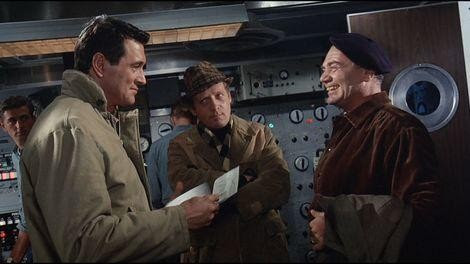
Ice Station Zebra. It's what long wet and miserable Sunday afternoons under heavy lockdown were made for. Particularly good old mad-as-toast McGoohan getting all the best lines. Including the pithiest ever description of the Cold War. 'The Russians put our camera made by our German scientists and your film made by your German scientists into their satellite. Made by their German scientists!'
Columbo. It was long wet and miserable Sunday afternoons under heavy lockdown were made for. Part the second.
The Serpent.
Staged.
The scriptwriter Philip Martin has died at the age of eighty two. Liverpool-born Martin was an acclaimed television writer who worked in British TV for over forty years. Beginning as an actor (he attended RADA and later appeared in series like No Hiding Place, Dixon Of Dock Green and the movie The Loneliness Of The Long Distance Runner) his writing early work included regular episodes on Z-Cars and New Scotland Yard in the late 1960s and early 1970s. His most famous work was the postmodern drama Gangsters. This was an examination of racial tension seen through an increasingly surreal vision of Birmingham's criminal underworld starring Maurice Colbourne, Ahmed Khalil, Saeed Jaffrey and Paul Barber. Beginning as an acclaimed one-off Play For Today in 1975, it was followed by two series in 1976 and 1978 and gained a cult following. Gangsters featured references to film noir, westerns, Bollywood and kung-fu movies, as well as increasingly surreal end-of-episode cliffhangers and a bizarre final scene where the characters not only broke the fourth wall but, actually, walked off the set. Martin himself appeared in the series in several roles, playing the gangland boss Rawlinson in the original play, the hired assassin The White Devil at the end of series two (though Martin was credited as Larson E Whipsnide, a reference to his WC Fields-inspired performance) and as himself, dictating the script to a typist, in cutaways throughout the final episode. He also wrote for The Bill, Thirty Minute Theatre and the memorable Find The Lady episode of Shoestring. His later work includes Tandoori Nights (1985), the under-rated Star Cops (1987), Virtual Murder (1992), several episodes of Hetty Wainthropp Investigates and Luifel & Luifel (2001). He also wrote the Doctor Who serials Vengeance On Varos (1985) and The Trial Of A Time Lord: Mindwarp (1986). He also wrote a script called Mission To Magnus which featured the character Sil (played by Nabil Shaban) from his previous serials. That was never filmed due to the show being laced on hiatus in 1985. A novelised version of the script, written by Martin, was published by Target Books in 1990. Martin's stage play Thee & Me, a work dealing with the effects of ozone depletion in the atmosphere in the year 2040, was staged at London's Lyttelton Theatre in February 1980, directed by Michael Rudman, but was withdrawn early from the repertoire because of poor reviews and 'appalling' ticket sales.
Gerry Marsden, who died aged seventy eight, was one of the prime movers of the Merseybeat sound of the early 1960s. For a short time, Marsden's band, Gerry & The Pacemakers, were vying with The Be-Atles (a popular beat combo of the 1960s, you might've heard of them) as Britain's toppermost of the poppermost group, both of them part of Brian Epstein's Liverpool-based NEMS management stable. In 1963 The Pacemakers topped the British charts with their first three singles, 'How Do You Do It?', 'I Like It' and a memorably swopping cover of the Rodgers and Hammerstein composition 'You'll Never Walk Alone' (which became an anthem for fans of Liverpool FC). In this respect The Pacemakers actually outstripped The Be-Atles, who did not manage to reach number one until their third single, 'From Me To You'. It was only in 1984 that The Pacemakers' feat was repeated, coincidentally by another Liverpool group, Frankie Goes To Hollywood. Aptly, the b-side of Frankie's first big hit, 'Relax', was a version of Marsden's composition 'Ferry Cross The Mersey', a Pacemakers hit from 1965. After their dazzling early salvo of hits, Gerry & The Pacemakers could not match the extraordinary trajectory of The Be-Atles, but, as Epstein predicted: 'Gerry will be with us for a great many years because you cannot exhaust natural ability.' The group enjoyed further successes with Marsden's song 'I'm The One', which reached number two in 1964, the poignant ballad 'Don't Let The Sun Catch You Crying' (written by Marsden and credited to the whole band and which made number six) and 'Ferry Cross The Mersey', which reached number eight in early 1965. Ferry Cross The Mersey was the theme of the film of the same name, scripted by the Coronation Street creator Tony Warren and starring the group playing thinly fictionalised versions of themselves. The song gave the group a top ten hit in the US in 1965, but it was their last major hit on either side off the Atlantic. Their final chart entry in Britain was 'Walk Hand In Hand' at the end of 1965. Gerry was born in the Dingle district of Liverpool, to Mary and Frederick Marsden. He attended Our Lady of Mount Carmel school, and at the Florence Institute youth club learned both how to box and to play the guitar. At fourteen, he joined a skiffle group, The Red Mountain Boys, with his brother Freddie (who was two years older) on drums, Les Chadwick on guitar and Arthur Mack on piano. They renamed themselves The Mars Bars, hoping to obtain sponsorship from the Mars confectionery company. Instead, Mars demanded that they change their name and, in 1959, the group became The Pacemakers. In June 1960 they played for the first time with The Be-Atles (then The Silver Beatals) and in December that year they were contracted to play a four-month stint in Hamburg, prompting the group to give up their day jobs and become professional musicians. 'We went over with The Beatles and had a good laugh,' Marsden later recalled. 'All they had over there were oompah bands. We took over this music and they loved it.' In 1961 Les Maguire replaced Mack. They played on the same bill as The Be-Atles numerous times over the following year and on 19 October 1961 the two groups merged to play a gig at Litherland Town Hall as The Beatmakers. In June 1962, just after The BeAtles had signed to EMI, The Pacemakers were signed for management by Epstein. In December that year The Be-Atles' producer George Martin saw them play at the Majestic Ballroom, Birkenhead and signed them to the Columbia label (also part of EMI). Martin had recorded Mitch Murray's 'How Do You Do It?' with The Be-Atles in 1962, but they did not like the song and came up with 'Please Please Me' instead. So, Martin took it to Marsden and co and told them that The Beatles' version was merely a demo and they should retain the arrangement as it was a guaranteed hit single. It became their first number one hit, in April 1963, selling half-a-million copies. In May 1967, with their chart appeal waning, the band announced their intention to quit, with Marsden planning to take over the lead role in the West End musical Charlie Girl from Joe Brown. The following month he released his first solo single, 'Please Let Them Be', which failed to chart. In 1968 he made his move to the London stage and released the single 'Liverpool', a duet with his Charlie Girl co-star Derek Nimmo. After the show ended in 1971, Marsden starred in another West End production, Pull Both Ends (1972). In 1970 he was given a regular slot on the children's TV programme The Sooty Show. In 1973 he put together a new Pacemakers for the British Re-Invasion Show at Madison Square Garden, where they appeared with other British pop contemporaries including The Searchers and Herman's Hermits. In 1974 the lure of the concert stage and requests from fans, proved irresistible. Gerry went back on the road with another version of The Pacemakers and released the single 'Remember (The Days Of Rock & Roll)' as Gerry Marsden and The Pacemakers. Marsden would continue to undertake tours with the band as well as cabaret shows in Europe, the US and Australia, while keeping up his TV work. In 1985 he oversaw the recording of 'You'll Never Walk Alone' by The Crowd,  a bizarre and unlikely host of showbusiness names, including Bruce Forsyth, Peter Cook, Rick Wakeman, subsequently convicted sex offender Dave Lee Travis, Motörhead and many more - to raise funds for victims of the fire at Bradford City football stadium. It reached number one in June, making Marsden the first artist to top the British charts with two versions of the same song. In April 1989, Marsden recorded another charity effort, when he joined Paul McCartney, The Christians, Holly Johnson and Stock, Aitken and Waterman in a new version of 'Ferry Cross The Mersey' three days after the Hillsborough disaster, which cost the lives of ninety six Liverpool fans. Marsden delivered an emotional performance of the song at the Liverpool versus Everton FA Cup Final at Wembley Stadium that year. In 1993 he published his autobiography, I'll Never Walk Alone, co-written with the former Melody Maker editor Ray Coleman. The book became the basis of the stage musical Ferry Cross The Mersey, which went on tour in the UK, Canada and Australia. In 2003 Marsden was appointed MBE for services to charity and in 2010 received an honorary fellowship from Liverpool John Moores University. He underwent heart surgery in 2003 and 2016 and in 2018 he announced his retirement. Nevertheless, he made a surprise appearance with Take That at their concert at Anfield in June 2019 and sang 'You'll Never Walk Alone' to celebrate Liverpool's Champions League win over Tottenham a few days earlier. He is survived by his wife, Pauline whom he married in 1965 and their daughters, Yvette and Victoria.
Manchester City legend Colin Bell has died, aged seventy-four, after a short illness, the Premier League club have announced. The former England midfielder - whose magnificent athleticism earned him the nickname Nijinsky, after the famed racehorse - made over five hundred appearances for City between 1966 and 1979, scoring one hundred and fifty three goals. He won forty caps for his country and played in the 1970 World Cup Finals. 'Few players have left such an indelible mark on City,' said a club statement on Tuesday. In 2004, Manchester City fans voted to name one of the stands at Etihad Stadium in Bell's honour. The Bell End. True story. 'Colin Bell will always be remembered as one of Manchester City's greatest players and the very sad news today of his passing will affect everybody connected to our club,' said City chairman Khaldoon Al Mubarak. 'I am fortunate to be able to speak regularly to his former manager and team-mates and it's clear to me that Colin was a player held in the highest regard by all those who had the privilege of playing alongside him or seeing him play. The passage of time does little to erase the memories of his genius.' After starting his career at Bury, Bell moved to Manchester City - then in the second tier - midway through the 1965-66 season in a forty seven thousand quid deal. He helped Joe Mercer and Malcolm Allison's team win promotion that season and was instrumental in The Blues winning the First Division title two years later. During his thirteen years as a player at Maine Road, he also won the FA Cup in 1969, the League Cup in 1970 and the European Cup Winners' Cup in the same year. It was a surprise that this lavishly talented and flamboyant City side never went on to even greater successes, but the partnership of Mercer and Allison fractured acrimoniously and further titles escaped them, most notably when the latter bought Rodney Marsh from Queens Park Rangers for two hundred grand in March 1972, only for the signing to disturb the balance of a finely-tuned side in control at the top of the First Division. They faltered and the title went to Brian Clough's Derby County. Bell, however, continued to forge a glowing reputation as one of the world's finest players, combining qualities of power, grace, creation and an ability to score crucial goals. He scored when City lost the 1974 League Cup final to Wolverhampton Wanderers and it was in that competition the following year, while still only twenty nine, that Bell sustained the devastating injury which was to effectively end his career at the highest level. It was in November 1975, as City demolished arch-rivals Manchester United four-nil in a League Cup fourth-round tie at Maine Road, that Bell damaged his knee so severely in a challenge with Martin Buchan that it took the best part of two years out of his career in its prime. After making a brief comeback later that season, he was injured again against Arsenal and was out for another eighteen months. When Bell came on as a second-half substitute to make a return in a game against Newcastle United on Boxing Day 1977, the prolonged ovation he received from City fans is still regarded as one of the most emotional moments witnessed at the famous old ground. However, he did not have the same freedom and mobility as he had done and played only a handful more games over the next two years. Bell finished his career with a brief spell in the United States playing for San Jose Earthquakes. He later returned to Manchester City to work with the club's young players, then as a club ambassador and enjoyed glorious successes as the Premier League and the big domestic trophies returned under their Abu Dhabi-based owners. In 2004, he was awarded an MBE for his services to football and remained a regular presence at City games in recent seasons. Former City team-mate Mike Summerbee described Bell as 'just the greatest footballer' the club has had. 'Colin was a lovely, humble man. He was a huge star for Manchester City but you would never have known it,' said Summerbee. 'He was quiet, unassuming and I always believe he never knew how good he actually was. [Current City midfielder] Kevin de Bruyne reminds me a lot of Colin in the way he plays and the way he is as a person.'
And finally, dear blog reader, a new From The North feature, Great Moments Of Rock and/or Roll History. Number one.

Saturday, January 02, 2021

"What's Past Is Prologue"

'Being with The Doctor, you don't get to choose when it stops. Whether you leave her or she leaves you.' So, dear blog reader, this blogger thought Revolution Of The Daleks was great. What was so great about it, you may be asking? Many things. Good old Barrowman going so far over the top he was down the other side. The captions. 'Morning Angela!' SAS Daleks. The return of The Mighty P'Ting. 'Take the car, just leave my face!' 'I'd forgot you were here.' 'This is why people don't like experts!' 'I was in Space Jail.' The Rose-in-a-parallel-universe bit. 'Are you feeling insecure? Cos you seem to need a lot of praise.' The quite beautiful Doctor and Ryan sequence. 'This is a PR disaster!' The TARDIS on top of the Clifton Suspension Bridge. 'All that product ... Maybe I can make a claim on insurance?' 'We didn't come this far just to get exterminated.' 'Stop talkin' weird, Graham!' 'Can you stop there and pretend there's no bad news?' 'I won't disappear again.' 'Yeah ... One day, you will.' 'Give us one good reason why we should save your life?' 'Money?' Plenty of round things. Emily Maitlis. Gwen. A Mike Ashley reference. The Meringue Galaxy. What, dear blog reader, was not to love? 'Two hearts. One happy, one sad.' 'I was wrong. We do get aliens in Sheffield.' This blogger thought Jodie was great. So were Bradley, Tosin and Mandip though the excellent Chris Noth got most of the best lines. That and a happy ending for Graham and Ryan. 'A few more tries then we go and save the world, eh?' We've missed you, so much Doctor. All of sudden, 2021 doesn't look quite as bad as it did twenty four hours ago.
'What about the other Daleks?' 'I'm dealing with them!'
'Jack, how do you feel about boarding an SAS Dalek ship?' 'Can I blow it up?' 'Yes please.' 'My kind of plan!'
The only down side, in fact, the only negative on display throughout was the unwelcome inclusion of a line of dialogue in which the collected works of a thoroughly offensive, allegedly transphobic author are now, seemingly, canonical in Doctor Who. Not even remotely cool. 
Still, that anomaly aside ... anyone fancy a new spin-off in which Graham and Ryan open O'Brien & Grandson's Cycling Proficiency School and, in their spare time, solve crime? 
Large-toothed cheeky-chappie Scouse comedian John Bishop is to join Jodie Whittaker and Mandip Gill for the thirteenth series of Doctor Who, the BBC has revealed in a teaser-trailer which immediately followed the New Year's Day episode. The fifty four-year-old, who recently tested positive for Coronavirus, said that boarding the TARDIS was a 'dream come true.' He will play a character called Dan, who 'becomes embroiled in the Doctor's adventures' and faces 'evil alien races beyond his wildest nightmares.' Manchester United supporters? Bishop fills the gap left by Bradley Walsh and Tosin Cole, who bowed out in the New Year's Day episode. Big Bish began filming his role last November, but the BBC kept the signing under wraps until the broadcast of Revolution Of The Daleks on Friday night. Bishop, who grew up on a Merseyside council estate, had a brief career as a professional footballer and worked in the pharmaceutical industry before turning his hand to comedy. He has previously acted - very well, as it happens - in the Channel Four drama Skins and the Ken Loach film Route Irish. He also had his own BBC chat show. Which, sadly, was a right load of old shat. But, hey, give the lad chance. Earlier this week, the comedian revealed that he and his wife had tested positive for Coronavirus over Christmas, saying he had been 'flattened' by 'the worst illness I have ever had.' Writing on Instagram, he described his symptoms as including 'incredible headaches, muscle and joint point, no appetite, nausea, dizziness [and] chronic fatigue like I didn't know existed.' He updated fans on New Year's Eve, saying he and his wife were 'getting a little stronger' every day, and promising he would 'return to work' in January. It is not thought that his illness will disrupt production on Doctor Who. The show is currently on a scheduled break for Christmas and not due to resume filming until later this month. The thirteenth series of the BBCs popular long-running family SF drama will see Whittaker return as the extra terrestrial Time Lord, alongside Mandip Gill, as Yaz. In a statement, Bishop said: 'If I could tell my younger self that one day I would be asked to step on board the TARDIS, I would never have believed it. It's an absolute dream come true to be joining Doctor Who and I couldn't wish for better company.' Showrunner Chris Chibnall added: 'It's time for the next chapter of Doctor Who and it starts with a man called Dan. Oh, we've had to keep this one secret for a long, long time. Our conversations started with John even before the pandemic hit. The character of Dan was built for him and it's a joy to have him aboard the TARDIS.'
That is, of course, if television still exists in 2021. And that cities have not 'gained sentience and raised themselves on hydraulic legs to begin the long battle for resources' four years earlier than previously predicted.
The latest Stark Trek: Discovery - There Is A Tide ... - was another rip-roaring rollercoaster this week.
The actor Mark Eden, who has died age ninety two, brought high drama to Coronation Street when he played Alan Bradley, who defrauded Rita Fairclough and then terrorised her - before meeting his very messy death under a Blackpool tram. Eden joined the TV drama in 1986, when Alan visited his estranged daughter, Jenny, while she was being fostered by Rita, following his ex-wife's death. Alan dated Rita, played by Barbara Knox, but two-timed her with the barmaid Gloria Todd. He was eventually dumped by Gloria and set up Weatherfield Security Systems - funded by stealing the deeds to Rita's house and posing as her late husband, Len, to remortgage it - and tried to rape his receptionist, Dawn Prescott. When Rita found out, he tried to suffocate her, was interrupted by Jenny, then fled. Although sentenced to two years in The Slammer, he was freed immediately after six months on remand. Alan took a job on a building site opposite Rita's home and started to torment her. When she disappeared, residents speculated that he had killed her, but she had suffered a breakdown and gone to Blackpool. He tracked her down, chased her across the prom and was, fatally but very satisfyingly, hit by a tram. Twenty-seven million punters tuned in on 8 December 1989 for the story's climax.
The actor was born Douglas Malin in London, the second of four children, to Mag and Charles Malin. Charles, a painter and decorator, was frequently unemployed. When the second world war broke out, Douglas was evacuated to Northamptonshire, then Derbyshire. He finished his education at St Aloysius' Catholic school, Highgate and left aged fourteen. to deliver telegrams for the Post Office. He then had several jobs, from builder's labourer and tailor's presser to packing reels for a film distributor. At the age of eighteen, he contracted tuberculosis and, during almost two years recovery in a sanatorium, spent much of his time in its library. 'I started to read Shakespeare and plays and the great writers, and realised there was a whole world I didn't know about,' he recalled. Then, in 1950, while working for a mail-order company between half-a-dozen seasons as a fairground worker, then photographer, in Margate, he saw Donald Wolfit playing Svengali in Trilby at The Bedford Theatre, Camden. When he told his mother he wanted to become an actor, she replied: 'Who's going to look at you?' That became the title of his 2010 autobiography. He joined the Everyman amateur theatre group in Ramsgate in 1956, three years after marrying Joan Long, a dental nurse. Two years later, he became an assistant stage manager at Swansea Grand Theatre's rep company and changed his name to Mark Eden. He made his professional acting debut at the Grand theatre, Llandudno. Playing Sergeant Mitchum in Willis Hall's The Long & The Short & The Tall (Richmond Theatre, 1959) brought him to the attention of the Royal Court Theatre's casting director and he was signed up to play the struggling Dave Simmonds in Arnold Wesker's Chicken Soup With Barley the following year. Two years later, he was Edward Sterne in the Royal Shakespeare Company's Aldwych Theatre production of A Penny For A Song - and said that his love for his fellow star Judi Dench was entirely unrequited. He turned down an offer by Peter Hall to join the company, seeing his future on screen - although he starred in the West End as T Lawrence Shannon, opposite Siân Phillips, in The Night Of The Iguana (Savoy Theatre, 1965). Eden's first TV appearance was in a small role as a journalist in Nigel Kneale and Rudolph Cartier's SF masterpiece Quatermass & The Pit (1958). He quickly became a prolific screen actor, with character roles in many popular series. He was Inspector Parker in four of Dorothy L Sayers's Lord Peter Wimsey dramas starring Ian Carmichael (1972 to 1974), Jack Rufus in London Belongs To Me (1977) and Superintendent Wilf Penfield in The Detective (1985). In the first series of Doctor Who, with William Hartnell, he took the title role in the much-acclaimed though now, sadly, lost fourth serial, Marco Polo (1964). Forty nine years later, he would play the BBC executive Donald Baverstock in Mark Gatiss's Doctor Who origin biopic An Adventure In Space & Time, his final screen role.
Starring roles came in Catch Hand (1964), as one of two itinerant labourers (with Anthony Booth) and Crime Buster (1968), as Ray Saxon, a cycling champion turned reporter investigating murder and corruption in the sports world. In a rare foray into comedy, Eden was Spencer alongside David Jason's clueless agent in The Top Secret Life Of Edgar Briggs (1974). There were also film parts as Terry in The L-Shaped Room (1962), the laxative company boss Geoffrey Despard in Heavens Above! (1963) with Peter Sellers and an engineer talking to Alec Guinness in the opening scene of Doctor Zhivago (1965). Plus a superb performance opposite Michael Gough and Rachel Gurney in 1965 The Edgar Wallace Mysteries TV movie Game For Three Losers about blackmail and homosexuality. Eden's quite extraordinary CV - in a career covering more than sixty years - also included appearances in Murder Bag, One Step Beyond, The Avengers, The Saint, Dimensions Of Fear, Armchair Theatre, Espionage, The Verdict Is Yours, Emergency Ward Ten, The Newcomers, Thirty Minute Theatre, Out Of The Unknown, Till Death Us Do Part, The Prisoner, Man In A Suitcase, Z Cars, The Troubleshooters, Beyond Belief, Coppers End, Spyder's Web, Clouds Of Witness, Jack The Ripper, Special Branch, The Rivals Of Sherlock Holmes, The Adventures Of Black Beauty, The Unpleasantness At The Bellona Club, New Scotland Yard, Sam, Warship, Zeffirelli's Jesus Of Nazareth, Poldark, Wilde Alliance, Cribb, The Sandbaggers, The Professionals, Crown Court, Poirot and Casualty. And, in movies such as Curse of The Crimson Alter, I'll Never Forget What's'isname, The Pleasure Girls, Nobody Ordered Love, Fern The Red Deer and Claudia. Eden's marriage to Long ended in divorce (she later married John Le Mesurier), as did his second marriage, to Diana Smith. He is survived by his third wife, the actress Sue Nicholls - one of his Coronation Street co-stars - whom he married in 1993 and by a daughter, Polly, stepson, Saul from the second marriage and grandaughter, Emma. A son, David, from his first marriage, predeceased him.
Tommy Docherty, who has died aged ninety, often liked to say that he'd 'had more clubs than Jack Nicklaus' - a joke that referred not to his successful playing career as a hard-tackling, intelligent international right-half, but to his peripatetic existence as a manager. Beginning with six years at Chelsea in the 1960s, which started brightly but ended in chaos, he had more than a dozen spells in management, including at Aston Villa, Queens Park Rangers, Derby County, Porto, Wolverhampton Wanderers and his own national side, Scotland. His most celebrated period came at Manchester United in the mid-1970s. Although he was one of the highest profile football managers of his generation and remained highly marketable well into the 1980s, Docherty's returns were actually rather slight, amounting over three decades to a Second Division title and FA Cup win with The Scum and a League Cup victory with Chelsea. He took all the ups-and-downs with his trademark ebullient humour and was ever willing to tell a story against himself. In 1967, after the Chelsea directors had called him to the boardroom and told him he was being released, he disappeared momentarily before returning with several bottles of champagne, with which he cheerfully toasted those who had just dismissed him. His enemies would say of him that you always knew he was lying because his lips moved - but he would make jokes about that as well. The son of Georgina, a cleaner and Thomas, who worked in an iron foundry, Docherty was born into poverty in the Gorbals and joined his first club, Glasgow Celtic, in 1948, after national service. At Parkhead he came under the aegis of the English coach Jimmy Hogan, who had managed Austria's national team to unprecedented levels of success and was considered one of the great pioneers of the game on the European continent. Hogan was an elderly man by then and was not always taken seriously in Britain. But the young Docherty was both open-minded enough and sufficiently bright to profit from Hogan's refined techniques, which he eventually carried into his own managerial career. He did not spend long with Celtic. In 1949 he was bought by Preston North End. Docherty made his debut as an outside-left, but soon settled into the right-half position as the ideal successor to another uncompromising Scot, Bill Shankly, then beginning an outstanding managerial career. Preston had slipped into the Second Division, but in the 1950-51 season Docherty helped them back up, playing in all forty two games; as he would the following season. He won the first of his twenty five Scotland caps in 1951 against Wales and in 1954 played in both of Scotland's World Cup finals games in Switzerland, the first narrowly lost one-nil to Austria, the second a seven-nil rout at the hands of Uruguay. He travelled to Sweden for the next World Cup finals in 1958, but did not get a game, unable to displace the veteran Eddie Turnbull of Hibernian. Docherty regained his international place the following season, however, winning another three caps while with Arsenal, whom he had joined in 1958. At Highbury he also figured sometimes successfully at centre-half. The 1961-62 season saw him move across London to Chelsea as a player-coach, making just four more appearances in the First Division and finishing his career having played more than four hundred league games for his various clubs. 
    The Chelsea manager, Ted Drake, was clearly coming to the end of his reign and in January 1962 Docherty succeeded him. It was too late to save Chelsea from relegation, but the following season the new manager, who was always ready to give youth its fling, bought and sold frenetically on the transfer market and gained promotion on goal average. Brian Mears, then a Chelsea director and later chairman, reported that his new charge was 'enthusiastic, swashbuckling, funny, outrageous, successful, rebellious, abusive, unbelievable' and 'always his own worst enemy.' Docherty, he said, acted on impulse, 'promising players one thing and then demanding it from the board, making fun of people behind their backs, playing practical jokes, saying ridiculous things to the newspapers, slagging players off one day and then asking them to die for him the next.' Clashes with players were a feature of his managerial life. At Chelsea, Terry Venables constantly locked horns with his manager and was eventually sold to Spurs. He was also one of eight Chelsea players controversially sent home by Docherty from Blackpool in 1965 before the penultimate game of the season. Docherty insisted the players had gone out the night before a game without permission; they argued the contrary and accused Docherty of courting publicity. Another future manager of renown, George Graham, was among the eight and although Peter Bonetti, the goalkeeper, was not, Docherty managed to fall out with him too. It would all eventually end in tears, although the club won the League Cup in 1965 and reached the 1967 FA Cup final, losing to Tottenham Hotspur. That summer Docherty was suspended for twenty eight days by the Football Association over an altercation with a referee during a club trip to Bermuda and his fate at Stamford Bridge was sealed. In October he officially resigned and was replaced by the markedly less exuberant Dave Sexton, who took Chelsea on to win the FA Cup in 1970 and the European Cup Winners' Cup the following year. 
    Docherty skidded down the league to manage Rotherham United in the 1967-68 season. Next came the first of his two spells with Queens Park Rangers, with whom he lasted for just three league games. Second Division Aston Villa promptly appointed him in December 1968 and he saved them from relegation. However, despite heavy expenditure under a new board of directors, the following season was disastrous and he was on his way again in January 1970 as his side languished at the bottom of the league. Technically this was the first time he had been sacked, but he was out of work only for a month, joining Porto in Portugal. He stayed there for almost a year-and-a-half before resigning in May 1971, having failed to break the stranglehold of Benfica and Sporting Lisbon in the league. Returning to Britain, he briefly became assistant manager to Terry Neill at Hull City, but left to become the caretaker manager of Scotland, taking on the job permanently before the end of 1971. In December 1972, with Scotland on the verge of qualifying for the 1974 World Cup finals in West Germany, he quit to take over at Manchester United. 'One of my biggest regrets was leaving the Scotland job when I did,' he later said. It was his work with Scotland that landed Docherty the manager's job at The Scum, as the Old Trafford hierarchy were looking to replace the incumbent, Frank O’Farrell and two of United's Scotland internationals, Willie Morgan and Denis Law, gave Docherty enthusiastic references. So it was that he began his hectic five years at United. History promptly repeated itself; they went down to the Second Division at the end of his first full season. But Docherty's attacking style was matched to the traditional expectations of the Old Trafford crowd and green shoots of recovery began to appear. In the Second Division he threw previous caution to the wind, used a fast young winger in Steve Coppell, from Tranmere and sped back into the First Division. The following season he signed Gordon Hill from Millwall and defied conventional wisdom by using two wingers. In 1976 United's rejuvenated team reached the FA Cup final, only to lose, sensationally, to Second Division Southampton. Docherty promised they would be back the following year and so they were, this time beating the favourites, Liverpool, two-one. The internal fallout from that victory was rather typical of Docherty's career. The manager had promised the team five thousand quid in cash if they won and handed it to the skipper, Martin Buchan, after the match. Buchan gave it back to him for safekeeping and never saw it again. There were many other alarums and excursions during his tenure, many of them prompted by Docherty's penchant for wheeling and dealing. When he arrived at the club he had set about buying and selling with his usual abandon and among those he had jettisoned was Law, who became deeply embittered and left for Manchester City, in due course scoring the goal that sent United down to the Second Division. George Best also dropped out of the club and there were harsh disagreements with Morgan, Alex Stepney and Pat Crerand, who was by then a managerial assistant. The Do”, as he was known, also had a reputation in which as a manager he was hardly alone - for treating his favoured players generously, but those whom he excluded abominably. He even became involved in a failed libel action against Morgan that led to a charge of perjury, of which he was acquitted. However, it was the public revelation of Docherty's extramarital affair with Mary Brown, the wife of the club physio Laurie, which led to his departure. He was sacked in a blaze of national publicity in July 1977 just two months after he had won United its first trophy in a decade and replaced by the same man who had followed him into the Chelsea manager's job, Dave Sexton. 
   Despite the scandal attached to him, Docherty remained employable for some time afterwards: at Derby for two years from 1977 to 1979; again at QPR; at Preston, fleetingly, in 1981 and at Wolves, by then a sinking ship, in 1984-85. Once he retired from football management he became a successful after-dinner speaker and through all his triumphs and disasters his sense of humour remained unalloyed. He is survived by Mary, whom he married after his first wife, Agnes, divorced him and by six children - three sons, Tom, Michael and Peter and a daughter, Catherine, from his first marriage and two daughters, Lucy and Grace, from his second.
Fireworks were going off in Walker Park at 6pm on New Year's Eve. Really loud ones, as it happens. And, let it be noted, very pretty ones, too (particularly if one turned the lights out to get the full effect as this blogger did half-a-mile away in the Stately Telly Topping Manor Plague House). But, em ... it was only 6pm, guys. Didn't you think it was worthwhile to wait another six hours? Or, were you working off Dhaka time?
Wait. Who spilled a bag of icing sugar overnight?
And, finally dear blog reader, if you fancy a really sobering look at just how badly affected the world has been by Covid-19 in just ten months, go to this link and check out the little video entitled How Confirmed Cases Of Coronavirus Have Spread about halfway down the page. It'll only take you thirty seconds but you will never, quite, see the world in the same way again.