Tuesday, November 09, 2021

"By The Pricking Of My Thumbs, Something Wicked This Way Comes"

Welcome, dearest bloggerisationism readers, to a somewhat shorter-than-usual From The North update. This blogger has been rather busy of late with a number of 'real-world'-type scenarios including a series of annual medical appointments (all of which were fine, if you're interested), a cracked tooth (which isn't fine but, hopefully, will be in a couple of weeks once this blogger has managed to get a dental appointment) and various other assorted shenanigans, malarkey and snarly-hoojar. Keith Telly Topping's life, dear blog reader, is a never-ending fiasco of stuff and, you know, more stuff. Anyway, on with the show. On Tuesday of this week, as threatened in a previous bloggerisationism update, this blogger - together with his beast fiend Young Malcolm - went to The Gate to see Edgar Wright's long-anticipated flick, Last Night In Soho. This blogger, as if there would be any doubt in such matters, though it was bloody great. 'This is London. Someone has died in every room and every building and on every street corner in the city.'
A proper, full-on horror movie which could only have been improved in that department if it'd had a Hammer logo at the end of it! Edgar has produced what is, probably, his most personal and easily identifiable movie (and, considering how much this blogger adores The Cornetto Trilogy, especially, Hot Fuzz, that's the highest of high praise). It's a film which is full of astonishing imagery and moments that will stay with you for days afterwards. Genre lovers will also have a lot of fun playing a game of 'spot the reference' - some obvious like Night Of The Living Dead - others more oblique but beautifully staged (Cabaret, Repulsion, A Matter Of Life & Death). There are magnificent performances from Thomasin McKenzie, Anya-Taylor Joy, Matt Smith, Terence Stamp, Pauline McLynn, Rita Tushingham and one, final, outstanding on-screen turn from the late, great Diana Rigg. And - one rather brilliant moment with a Siouxsie & The Banshees tune aside - a stunning Sixties soundtrack ('World Without Love', 'You're My World', 'There's A Ghost In My House', 'Downtown', 'Heatwave', 'Land Of A Thousand Dances' et cetera), plus Steven Price's original score which is equal parts John Barry and James Bernard.
As From The North favourite, the BBC's Mark Kermode noted it was 'maximum Edgar Wright ... it taps into some many things that I love, the idea of walking the streets of a town that have the past living in them. I loved the way it starts out as The Amazing Mister Blunden and ends up as a giallo slasher.' Edgar Wright has, reportedly, said that Chris Nolan saw the trailer for Last Night In Soho and told Edgar: 'Wow, it's like you've made Peeping Tom-Meets-Tom's Midnight Garden!' And, Peeping Tom's Midnight Garden is a perfect description of this incredible movie experience. (Sadly, Mark was on holiday from Radio 5's film review show the week Last Night In Soho came out, but he did get to review it on the BBC News channel and in the Observer, whilst his stand-in Anna Bogutskaya also gave it a rave review.) Just to repeat, this blogger thought it was bloody great.
'If we all of us waited to be sent for, we would none of us find our purpose.' Moving swiftly on to the second episode of the current series of From The North favourite, Doctor Who, this blogger also thought that War Of The Sontarans was great. No major surprise there but, after the shocking - and stunning - surprise of The Halloween Apocalypse being 'really rather terrific with no prior expectations', it's nice to see that the series is maintaining a quality of punchable menace mixed with some fabulous comedy (the use of a wok as a Sontaran-disabling weapon, for a kick-off!)
This blogger loved the fact that Dan's parents were introduced, got two really good (and very funny) scenes and then pissed off; which was such a refreshing change from all the companion relatives we've met since Jackie Tyler who just hang around and, occasionally, get given something to do to justify their existence. And, not only was the episode great but then there was the trailer for next Sunday's third installment featuring a spoilerific-but-fantastically-awesome appearance by ... someone (or, actually, several someones). So, it looks like Flux is shaping up to be a kind-of 'Doctor Who's Greatest Hits'-type affair with the added bonus of a sinister atmosphere and a central villain who seems to know more about The Doctor than The Doctor her very self does. 'Time is evil and it will seek its own.' Good grief, even the Gruniad Morning Star liked it.
Next, how excellent it was that this blogger's usual record of watching an episode of From The North favourite Only Connect and guessing the answer to at least one question correct before either of the two teams did was maintained. And, as usual, this week, it was the movie-related question.
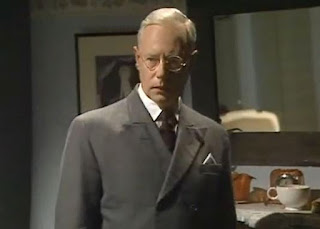
A sad note, now: One of this blogger's favourite actors, Clifford Rose, has died at the age of ninety two. Many From The North dear blog readers will know Clifford best from his appearance in Doctor Who in the acclaimed 1981 Tom Baker serial Warriors' Gate (written by Steve Gallagher) where he played Rorvik the captain of the privateer ship that transported the time-sensitive Tharils between dimensions. He was most famous to the wider public for his powerful portrayal of Standartenführer Ludwig Kessler, the ruthless Gestapo officer, in three series of the BBC's Secret Army and then in its less-succssful-but-actually-much-better-than-its-lowly-reputation-suggests sequel, Kessler. 
    Clifford was born in Herefordshire in October 1929. After studying at King's College London he sought a career as an actor appearing in repertory theatre and later as a founding member of the Royal Shakespeare Company. His first TV appearance was in 1959, in an adaptation of Arnold Bennett's Hilda Lessways. Many character roles followed including appearances in series such as Roads To Freedom, Elizabeth R, Callan, Justice, The Pallisers, How Green Was My Valley, Inspector Morse, One By One, Hammer House Of Mystery & Suspense, Reilly: Ace Of Spies, Rooms, Dixon Of Dock Green, Follyfoot, The Troubleshooters, Woodstock and The Devil's Crown. And also in movies like Marat/Sade, Tell Me Lies, Work Is A Four-Letter Word, The Good Father and The Girl. In 1977 he was cast as Sturmbannführer Kessler in Secret Army, the series detailing the work of the prisoner evasion lines which helped Allied pilots escape from occupied Belgium during World War II. It was a powerful multi-layered performance which explored the ruthlessness of the Nazi commander as well as his personal qualities as he fell in love with a Belgium woman. His performance saw the character return in his own spin-off, Kessler, exploring the fate of the character who had reinvented himself as an industrialist in post-war Germany. He later played SS General Kammler in the mini-series War & Remembrance, appeared in Fortunes Of War and played Judge Critchley in Alan Bleasdale's memorable Channel Four drama GBH. Later film appearances included roles in Pirates Of The Caribbean: On Stranger Tides and The Iron Lady and he played the Dean of Windsor in The Crown, his final screen role. He also played King George V in the TV movie Wallis & Edward (2005). In 2008, he appeared in the ITV historical drama Foyle's War. Rose also played The Judge in Enid Bagnold's The Chalk Garden in a production at The Donmar Warehouse for which won The Clarence Derwent Award. A radio adaptation of the staging was broadcast on Radio 3 in 2011. Clifford was married to Celia Ryder from 1957 until her death in 2012. They had two children - Jonathan and Rosalind - and lived in Stratford-upon-Avon.
The actor Dean Stockwell, who has died aged eight five, enjoyed periods of acclaim punctuated by bouts of sometimes self-inflicted obscurity, but found his widest audience in a recurring role on television in Quantum Leap (1989 to 1993). The series followed a physicist, Doctor Sam Beckett (Scott Bakula), on time-travelling expeditions to correct historical injustices. Stockwell played Admiral Al Calavicci, Beckett's cigar-smoking and womanising best friend who appears to him in hologram form to offer guidance as the experiments unfold. While the series used Sam's endeavours to facilitate social commentary, the cigar-chomping Al served as a comic pick-me-up: world-weary, witty and charismatic. Bakula said: 'I loved him dearly and was honoured to know him. He made me a better human being.' In 1990 Stockwell won a Golden Globe for his performance. In a 1994 interview, Stockwell said: 'I have a particular fondness for [Al]. I guess people say that actors take a little bit of the part away with them, but if I really was as streetwise and cocky as Al, I'd probably have been a bigger star.' His acting career began when he was seven. As a child, he was praised for performances including the title role in Joseph Losey's anti-war allegory The Boy With Green Hair (1948). As a young adult, he received awards for work such as the thriller Compulsion (1959), based on the Leopold and Loeb case. During his late-period comeback, he was used by film-makers such as Robert Altman (The Player, 1992), David Lynch (Dune, 1984 and Blue Velvet, 1986) and Wim Wenders (Paris, Texas, 1984). But throughout his working life, he regarded his profession with ambivalence; this contributed to his unpredictable quality. 'He's such a chameleon,' said Jonathan Demme, who cast Stockwell as a flamboyant mafia kingpin in the 1988 comedy Married To The Mob, a performance for which the actor received his only Oscar nomination. 'That's what makes him special - he has such mercurial presence.' Stockwell called it 'the favourite part I've ever had in a film.' He said' "I just felt that that part was just perfect for me and I had a way to approach it that I thought was just right and it turned out that way.' Stockwell recognised his own off-kilter appeal: 'In my work, I'm dealing with something that is essentially mysterious and I prefer and am inclined to deal with it in a mysterious way.' 
     He was born in Los Angeles to Harry Stockwell, an actor who provided the voice of Prince Charming in Disney's Snow White & The Seven Dwarfs and Nina Olivette, an Italian-American vaudeville entertainer sometimes known as Betty Veronica. They separated when Dean was six; he and his elder brother, Guy (also an actor), remained with their mother. Both siblings were appearing on Broadway in the play The Innocent Voyage when the seven-year-old Stockwell was spotted by a talent scout. He was put under contract by MGM and schooled on the studio lot in between making several films a year, including Anchors Aweigh and Abbott & Costello In Hollywood (both in 1945). At fourteen, he played the lead in an adaptation of Kipling's novel Kim and was befriended by his co-star Errol Flynn who, according to Stockwell, asked in front of his mother 'Have you had your first fuck yet?' Stockwell spoke frequently of the 'extreme psychological and emotional pressure' to which he was subjected as a child star. 'A lot of demands were placed on me that should not be placed on a child, at all, ever ... I resented the whole thing.' Celebrity brought Stockwell no pleasure. 'I was under siege, under attack. At the end of the day, when I left MGM, there were hundreds of people waiting for me. It was a dreadful experience.' After graduating from high school, he travelled and took menial jobs for five years, but returned to acting in 1957 because 'there was nothing else I could do.' He landed one of the leads in the Broadway production of Compulsion and reprised the role two years later on film. He starred in adaptations of DH Lawrence's Sons & Lovers (1960) and Eugene O'Neill's Long Day's Journey Into Night (1962); the latter, directed by Sidney Lumet, won Stockwell his second Cannes film festival acting prize. (The festival had already honoured him with an award for Compulsion.) But his behaviour became self-destructive. He split from his wife, the actor Millie Perkins, after two years of marriage; she alleged mental cruelty. He destroyed his Cannes awards in a drunken rage. He quit acting again for three years and embraced the hedonistic culture of 1960s Los Angeles, fraternising with like-minded friends including Dennis Hopper, Jack Nicholson and Neil Young (with whom he would co-write and co-direct the ramshackle 1982 comedy Human Highway). 'The flower children and the love-ins ... were the childhood I didn't have,' he said, later. 'I did some drugs and went to some love-ins. The experience of those days provided me with a huge, panoramic view of my existence that I didn't have before. I have no regrets.' When he returned to acting in the late 1960s, he was more of an outsider than ever. After several films for Roger Corman's AIP and a part in Hopper's The Last Movie (1971), film work grew scarce. During the 1970s, when not appearing in curiosities (The Werewolf Of Washington or Henry Jaglom's post-Vietnam drama Tracks), Stockwell could be found performing on the dinner-theatre circuit. His financial situation became so dire that he decamped to Santa Fe with the intention of making a living in property. (An advert placed in 1983 read: 'Dean Stockwell will help you with all your real estate needs.') But in 1984 a role in Lynch's science-fiction extravaganza Dune distracted him from that path. In the same year, his friend Harry Dean Stanton, who was about to play the lead in Wenders's Paris, Texas, suggested Stockwell to the director for a supporting part. The film won the Palme d'Or at Cannes and helped to revive Stockwell's career. His fortunes changed dramatically. He starred in three films for Francis Ford Coppola, Gardens Of Stone, Tucker: The Man & His Dream (in which he played Howard Hughes) and The Rainmaker. He was also a sinister, enigmatic presence in Lynch's Blue Velvet, for which he devised his character Ben's drugged, dandyish look. 'To me it was the high point of the film,' said his co-star Hopper. 'The white make-up, the batting eyelashes - Dean has ways no other actor can touch.' These movies and others including William Friedkin's To Live & Die In LA and Altman's The Player, made definitive Stockwell's return to cinema. Though he continued to work in that medium, his most noteworthy latter-day appearances came in science-fiction television: following Quantum Leap he had guest roles in Star Trek: Enterprise and Stargate SG-1 and was a regular on the highly regarded Battlestar Galactica (2006 to 2009). He also enjoyed a career as an artist, using the name Robert Dean Stockwell. Away from the screen, Stockwell was also a keen photographer and a picture he took of the Californian artist Wallace Berman was used in the collage on The Be-Atles' Sgt Pepper's Lonely Hearts Club Band cover. His representatives told the BBC he died peacefully at home on Sunday. A statement said: 'Dean spent a lifetime yo-yoing back and forth between fame and anonymity. Because of that, when he had a job, he was grateful. He never took the business for granted. He was a rebel, wildly talented and always a breath of fresh air. He loved to act, to laugh, smoke cigars and play golf.' He is survived by two children, Austin and Sophia, from a second marriage, to Joy Marchenko, which also ended in divorce.
Former television commentator Gerald Sinstadt has died at the age of ninety one. Sinstadt's work for the BBC and ITV made him one of football broadcasting's most recognisable voices in the 1970s after starting at Granada Television. From 1970 to 1982, he covered four World Cups for ITV and later worked on coverage of the Olympics for the BBC. 'He was a craftsman, a very good commentator and just a lovely man,' said Andrew Clement, who worked with Sinstadt at the BBC for about thirty years. While racist taunts from the terraces during the 1970s were often overlooked by football commentators, Sinstadt was one of the first to call out the abuse during his commentary, such as during West Bromwich Albion's five-three win at Manchester United in 1978. He commentated on many other iconic games of that period, including Denis Law's back-heeled goal for Manchester City against United in 1974 which sent United down to the Second Division and Liverpool's European Cup Quarter-Final second-leg win against St Etienne in 1977 at a rocking Anfield. He also covered West Germany's victory against France in their controversial 1982 World Cup semi-final and Diego Maradona's goal at the 1994 World Cup prior to his expulsion from the tournament for sniffing up half the gross national product of Columbia pre-match. After rejoining the BBC in the 1980s, Sinstadt was the pitchside reporter on the day of the Hillsborough disaster in 1989 and appeared in Jimmy McGovern's 1996 TV docu-drama about the tragedy. He also covered rower Sir Steve Redgrave winning the first four of his five Olympic gold medals and the Boat Race for the BBC. Sinstadt was a regular on Football Focus, Match Of The Day and Final Score until his retirement. Towards the end of his career he was often called on to write and voice obituaries. 'He taught me a lot,' said BBC Sport executive producer Clement. 'He was very generous with his time and was a wonderful mentor to a lot of us as we started off in television. He was a fantastic wordsmith, particularly when paying tribute to some of the greats of the game in obituaries. is use of language was second to none and he was brilliant at putting words to pictures. He used to sit in on the edit, which was rare in those days. If I produced a shot for him, he would bring it to life with a perfectly chosen phrase or image. He crafted his pieces.' His path to broadcasting might not have happened but for a cruel twist of fate involving his parents. Sinstadt, born in 1930, was the only child of shopkeepers in Folkestone and was evacuated during the Second World War. Later, reflecting on the tragic death of the pair in a German air raid, he said: 'I can still remember my teacher taking me out of class to tell me the news. I have wondered what might have been if my parents had survived. Who knows, I may have followed my dad and become a shopkeeper.' Sinstadt started his career in 1949 on the British Forces Broadcasting Service, where he met Barry Davies. Upon their return to the UK, Sinstadt helped Davies join him on BBC Radio, where the former worked in the 1950s and 1960s and both became two of the most recognisable voices in sports broadcasting in the 1970s. Davies said: 'He gave me my first job in broadcasting. That was his one big mistake! We went on to cover many games together and he was a very good commentator, for radio and television.' The young Sinstadt made his first live commentary in 1949 for Forces Radio after his conscription into national service and was rewarded with a seven-six cup game between an English and Scottish regiment. 'The game made my job easy and I thought: "Hang on, I can do this,"' he recalled. 'Unfortunately, I soon realised you couldn't just turn up on the day and hope for the best. If you don't do your proper research the listener will soon catch you out.' After time on BBC radio and Anglia Television, Sinstadt's informed but distinctively dry style became a feature of Granada TV's Kick Off preview and of highlights shows on ITV from 1969 to 1981 when he became the station's full-time football commentator. Sinstadt also commentated on golf for Channel Four and in 1987 was the first to voice the long-running Trans World Sport show. Away from sport he also produced TV programmes on his other big passion, opera. Having settled in the Potteries, after his retirement Sinstadt continued to write a weekly column for the Stoke Sentinel until 2019.
A previously unheard song featuring two of The Be-Atles at the height of their fame has been given its world premiere after being rediscovered in a loft. The Be-Atles were a popular beat combo of the 1960s, you might've heard of them. The song, 'Radhe Shaam', was written and produced by the broadcaster Suresh Joshi in 1968 and features yer actual Ringo Starr on drums and the very George Harrison on guitar. It was unearthed at the seventy five-year-old's Birmingham home by a friend who was checking on him during lockdown. The song was played to one hundred people at Liverpool Beatles Museum this week. Joshi, who was friends with George Harrison, was working on the music for a documentary film, called East Meets West, at the Trident Studios in Soho, when Harrison and Beatles bandmate Ringo Starr turned up and offered to play. The pair were taking a break from recording 'Hey Jude' at the studios at the time. The song also featured renowned Indian classical musician Aashish Khan but Joshi said they never got round to releasing it. 'Time had gone on, [then] The Beatles were breaking up and had various problems so no-one wanted to [release it],' he said. However he said the coronavirus lockdown was 'a blessing in disguise as we had nothing to do.' He said he had been telling his friend, Deepak Pathak, about his musical past and - as a Beatles fan - he insisted they look for the tape. Having unearthed it, Pathak sent it to music producer Suraj Shinh, who restored the tape and mixed the song. Joshi said his song was still relevant today. 'The song itself revolves around the concept that we are all one and that the world is our oyster,' he said. '[That is] something that we have all realised during this pandemic.' Liverpool Beatles Museum manager Paul Parry said the invited audience who heard the song had 'loved it.' He said the song was 'absolutely amazing', adding that George and Ringo's contributions were 'unmistakeably' the work of the pair. The song has also been given its first radio play on BBC Merseyside.
And finally, dear blog reader, one of the - several - reasons for the shortness of this bloggerisationism update and for this blogger's general lack of online activity of late has been that he's been busy compiling From The North's fourteenth annual Best and Worst TV of the year blog which he is now in the process of putting the finishing touches to. The next From The North bloggerisationism update will, as a consequence, be longer than this. Much longer. Keep your mincers peeled for that one in approximately a week's time.

Sunday, October 31, 2021

The Halloween Apocalypse: "Exit, Pursued By A Bear"

'What is it you're saving them from?' 'You don't know?' 'I've been busy.' 'The Flux.' 'What's The Flux?' 'A hurricane ripping through the structure of this universe disrupting every particle, the falling of the structure of the universe. A cataclysm of unknown proportions or patterns. We don't know for sure.' 'And when is this Flux supposed to happen?' 'It's already begun.'
'What was it he said? "The final few hours of planet Earth?" He doesn't get rid of us that easily!'
'Renewed at last.' 'What have you done?' 'I waited ... Your time is done, as mine has begun once more.'
'What's the matter with me? I'm not the one breaking into people's houses dressed as a dog.'
'Look at your little brain trying to work it all out. Embarrassing.'
'A quick check on my mind, I had a little ... glitch earlier!'
'Nothing ever changes. But then, you know that.'
'I must admit, Yaz, I can't help feeling some of this is my fault!'
'Why is this thought in my mind?' 'What thought?' 'Thank you.'
'What's the matter with Sheffield?' 'It's too near Leeds!'
'Also, one other thing is bugging me, a tiny detail. Why does Dan have such a flashy computer?' 'Because, it's not his!'
'Don't be throwin' eggs at my 'ouse!' Well dear blog reader, what do you know? This blogger actually thought that was great. Which is, in fact, far more unusual than even long-term From The North dear blog readers may have thought. Primarily because, this blogger had avoided all pre-series publicity and trailers and, as a consequence, knew not what to expect from The Halloween Apocalypse. Apart from the presence of large-toothed wacky Scouse funster John Bishop, obviously - we've all known that was happening since New Year's Day. So, anyway - as The Clash once asked, what do we have for entertainment? We have - and the list is not all-encompassing - Weeping Angels, Sontarans, Dog-Faced shooty-type individuals, Green-Skinned (and, now, very dead) aliens, the Cloister Bell, a spooky house, an ancient (but, entirely unknown to The Doctor) enemy, something up with the TARDIS doors and a properly outrageous, 'get out of that one' cliffhanger ... What's not to love?
'The end of the universe. I always wondered what it would feel like!' Doctor Who, dear blog reader. It never ceased to amaze this blogger.

Wednesday, October 06, 2021

"His Words Are Bonds, His Oaths Are Oracles, His Love Sincere, His Thoughts Immaculate"

So, dear blog reader, as Keith Telly Topping mentioned in the last-but-one From The North bloggerisationisms update, Tuesday of this week had been pencilled-in for this blogger's second post-lockdown cinema visit, this time for to see No Time To Die. And, it being a horrible, miserable, rainy day notwithstanding that is, indeed, what occurred. Just thought you'd be interested.
Given that Diamonds Are Forever was the fourth movie that this blogger was ever taken to see as a both shaken-and-stirred eight year old and, two years later, Live & Let Die was the seventh, attending a new Bond flick a few days after its opening was hardly a significantly out-of-character step for this blogger to have taken. And, thus it was that - with his beast fiend and fellow life-long Bond devotee, Young Malcolm - this blogger attended a shortly-after-1pm screening (half-an-hour's worth of adverts and trailers being an unwanted necessity) of the twenty fifth film in the most successful movie franchise of all time at Newcastle's Cineworld multiplex in The Gate. Which was nice.
The short review, of course, is that this blogger thought it was great. Which, he trusts, is as little a surprise to you, dear blog reader, as it was/is to him. Especially given that the reviews - at least from most UK critics - have been, by and large, wildly positive and that the opening weekend's takings were astronomical; something to which this blogger has now contributed. A few, slightly more verbose, comments need to be made to go with 'Keith Telly Topping thought it was great,' however. (If you're wondering, Young Malcolm expressed the opinion that he thoroughly enjoyed it, too.) Firstly, the length: In common with just about every Bond movie since the mid-sixties, No Time To Die was overlong. At one hundred and sixty three minutes, a good half-an-hour too long. As has been the case with, again, just about every Bond movie in some considerable time, it could easily have done with losing twenty minutes or so, at least - this blogger even extends this observation to the shortest Bond movie in living memory, A Quantum Of Solace which, at one hundred and seven minutes, was still at least twenty minutes too long. Actually, in that particular case, it was about one hundred and seven minutes too long.) From The North favourite and Britain's finest film reviewer Mark Kermode has often commented in the past that any movie which is longer than one hundred and forty one minutes needs to work really hard to justify its existence. The reason being that one hundred and forty one minutes is the length of 2001: A Space Odyssey and, in that movie, Stanley Kubrick managed to go from The Dawn Of Civilisation to the birth of a new species. Thus, if you're spending more than two hours and twenty one minutes establishing your narrative, make sure you don't pad it to buggery. (Mark, incidentally, loved No Time To Die, with a few, minor, reservations and, so did his mate, Simon Mayo, as you can discover, here.) So, yeah, it was a bit too long. Then again, so was The Spy Who Loved Me. So was The Living Daylights and Goldeneye and Skyfall. All four of those are also great and, to repeat, so is No Time To Die - and, unlike in the case of Skyfall where the obvious twenty minutes to cut was the entire Macau subplot, in No Time To Die there was no blindingly obvious, 'the movie would've lost nothing if they'd cut that bit' which stuck out like a sore thumb. So, for once, ending the movie with a jolly numb bum and having to rub ones legs vigorously to get them working again as the titles rolled was a small price to pay.
The screenplay by series regulars Neal Purvis and Robert Wade, the director Cary Joji Fukunaga and From The North favourite, the excellent Phoebe Waller-Bridge managed to avoid a common problem with scripts written by committee, that is feeling like a script written by committee. One or two reviews - included Kermode's mentioned above - have suggested that the movie was rather 'set-piecey' shifting the narrative all over the place in a series of individual subplots, some of which seemed to have little obvious link to other aspects of the overall plot. This blogger doesn't buy that. If there's one thing that No Time To Die did really well, it was make the audience follow the narrative with an economy that isn't always there in a Bond film (I'm looking at you, Tomorrow Never Dies). One thing which this blogger does agree with yer man Kermode about (other than the fact that it was great) was the suggestion that Waller-Bridge's contributions had mainly been to provide the - often superb - comedy zingers and general pith at which the movie excels. It's perfectly possible that she did but that rather undermines a fine author who, as her astonishing work of the first series of Killing Eve proved, can write action and drama just as well as she writes sharp, sarky dialogue and excellent one-liners. That said, is it wrong to be utterly convinced - as this blogger is - that the entire Bond-in-Cuba sequence featuring the brilliant Paloma (Ana de Armas), possibly the best new Bond character in half-a-dozen movies, was largely the work of Pheebs her very self? Elsewhere, as usual Ben Wishaw gets most of the dryly pithy lines (well, at least, the ones that Rory Kinnear doesn't get). And, in just a couple of scenes, Christoph Waltz was given the opportunity, once-again, to do his wonderfully entertaining so-far-over-the-top-he's-down-the-other-side routine with aplomb. Which certainly helped to make up for a curious lack of humour in the film's main villain, played with just the right degree of nostril-flaring, eye-rolling, scenery-chewing intensity by Rami Malek.
The music was pretty good - Billie Eilish's theme song was obviously going for the Adele, Skyfall, 'you can sort-of imagine Dame Shirley belting this one out in Studio One at Abbey Road' vibe and, for the most part, succeeded. No, it's not the most memorable Bond theme of recent vintage, although it's in a different league to Sheryl Crow, Jack White and Alysia Keys, Madonna and Duran Duran. Let's face it, dear blog reader, Bond themes tend to age gracefully or be utterly forgettable. We're probably never going to get another 'Diamonds Or Forever' or 'Live & Let Die' or 'Nobody Does It Better' (much less another 'Goldfinger' or 'You Only Live Twice'). But, so long as we don't get too many 'All Time High's or 'View To A Kill's then we can, at least, think 'hmmm ... the song's okay, oh, it's finished, the movie's started.' Hans Zimmer's score was really rather good - heavily influenced (as with several aspects of the plot, if that isn't too much of a spoiler for those who have yet to see the movie) by one of John Barry's greatest hits, On Her Majesty's Secret Service. The guitar work - by From The North favourite Johnny Marr - was particularly impressive.
Bits this blogger particularly liked: The portraits of Judi Dench and Robert Brown in MI6 (one presumes there was also one of Bernard Lee in there somewhere). The fact that, unlike in, say, The World Is Not Enough, they managed to construct a pre-title sequence in under forty minutes. Just. The entire Cuba sequence (especially the bit with the hidden tuxedo). Bond and Moneypenny interrupting Q's evening of 'entertaining' (and Q's very poor attempts at convincing M he's surprised to see Bond alive and well). The Bond-Blofeld scene in Belmarsh. The Bond-Nomi's verbal duelling. A nice cameo for Hugh Dennis. Madeleine's lethal use of a cup of tea. The moment when James didn't say 'this never happened to the other fellah(s)' as something quite unexpected happened five minutes before the end. The last scene. 
       Bits that made this blogger go 'hmmm': The fact that, according to her grave, Vespa Lynd was twenty two or twenty three at the time of Casino Royale (Eva Green was twenty seven and she looked it!) David Denick's 'wacky minor Russian villain' who manages to say 'Chames Bondt' twice without sounding remotely convincing. The glider. But, they're minor points, really. Once again, at the risk of sounding like a broken record, this blogger thought it was great. And, among the best things in it was Danny Craig who, yet again, played a Bond used to loss, heartbreak, pain and suffering. A Bond that, let us remember, more than a few planks back in 2005 - sight-unseen - took issue with. Four of Craig's five Bond movies have been utterly terrific, for many different reasons but, always, because of him (and, with regard to A Question Of Sport, he wasn't in any way the reason that particular pile of rancid diarrhoea didn't work). Whomsoever has the job of replacing him in the franchise has big boots to fill. One doesn't envy the responsibility that the next owner of the hardest working libido in the intelligence service will face. But, importantly, James Bond will return. And, he will return with a clean slate as well as a new face. MI6's Time Lord's next regeneration is going to be fascinating to observe.
So, dear blog reader, just to repeat again, this blogger thought No Time To Die was great. Not Danny's best (Skyfall still ,just about takes that honour), but right up there with Casino Royale and Spectre. And From Russia With Love. And The Spy Who Loved Me. And The Living Daylights. And On Her Majesty's Secret Service. A film about a blunt instrument who does what is necessary when a trigger needs to be pulled. Someone once told him 'names is for tombstones, baby.' For a man who faces such an ending every day, James Bond has had a remarkable run. And, he's still running. Shaken, maybe but never, ever, stirred. 
One of the - few - highlights of sitting through half-an-hour of annoying pre-movie adverts was the first opportunity to watch the trailer for Edgar Wright's forthcoming Swinging London psychological horror movie Last Night In Soho which opens in the UK at the end of this month. This blogger has been eagerly anticipating this movie for a long time (so long, in fact, that Matt Smith was probably still The Doctor when it was first announced!) With a cast that includes Smudger his very self, Anya Taylor-Joy, the Godlike Genius that is Terence Stamp and, in her final big screen role, Diana Rigg even without having the director of Hot Fuzz behind the camera it would probably be worthwhile. This blogger and Young Malcolm decided, of an instant, this would be our next joint trip to the flicks. Again, it's had some startlingly good reviews from the likes of the Torygraph and Gruniad (and one sniffy one from some prick of no importance at Vanity Fair). So, this blogger is really looking forward to that. 
And finally, dear blog reader, as mentioned at the beginning of this From The North bloggerisationisms update, the weather was pure-dead filthy on Tuesday morning, so it was. A slate-grey sky and the rain was lashing down like The Flood had returned. This blogger had arranged to meet Young Malcolm just before 1pm at the cinema and, although he had a few bits and pieces of shopping to do beforehand, he was leaving it as late as possible to vacate the safety of The Stately Telly Topping Manor Plague House on the off-change that it might just stop stotting-it-doon for five minutes so this blogger could get to the bus stop in a post-diluvium state without getting, you know, drowned. That didn't look likely for most of the morning and, as the time approached 11.30, it appeared increasingly as though a thorough soaking was going to be the order of the day. And then, miraculously, the rain stopped. It still wasn't exactly a bright sunny day, remaining overcast and with occasional short busts of misty precipitation but, at least, this blogger managed to get the twelve up to town, do a quick round of Morrison's, the bank, Poundland, Boots, Greggs, Wilkinson's and, because he was still twenty minutes early, Starbucks without getting drenched through to his vest. And, after the movie, it was still just about dry enough for us to have a quick soft drink in the nearest rubba before getting the bus home. It was almost as if some divine force was looking upon yer actual Keith Telly Topping and thinking 'you shall be dry today.' Would that this was always the way, dear blog reader. Of course, it isn't and his blogger can pretty much guarantee that, the next time he ventures forth from The Stately Telly Topping Manor Plague Hour - say, to grab a nice yung-chow fried rice, curry and chip from the local takeaway - he likely to return to his gaff with his shoes squelching. 
      Anyway, like James Bond, From The North will return ... 

Saturday, September 25, 2021

"The Future's Bright. The Future's Rusty"

Screenwriter, producer and all-round top-bloke yer actual Russell Davies is to take charge again of Doctor Who, the BBC's popular, long-running family SF drama which he helped to revive so successfully in 2005. Big Rusty, who was the drama's showrunner until 2009, will take over when Chris Chibnall departs next year. 'I'm beyond excited to be back on my favourite show,' said Davies (seen below, auditioning successfully for the role of Batman), who resumes his role as Doctor Who prepares to mark its sixtieth anniversary in 2023. 
One of Big Rusty's first responsibilities will be to decide who will take over the TARDIS controls following Jodie Whittaker's exit. The actress is set to hang up her Sonic Screwdriver and get back into some normal clothes after one further six-part series to be broadcast later this year and then three 2022 specials. In a statement, Davies said it would be 'time-travelling too fast' to speculate at this early stage as to what will actually happen when he returns to the production. Not, as this blogger has noted previously, that such a detail will stop much idle, ill-informed, crass and downright daft speculation being published in the popular media, argued over on the Interweb or talked about, loudly, in pubs. Plus ça change, plus c'est la même chose, dear blog reader. 'There's a whole series of Jodie Whittaker's brilliant Doctor for me to enjoy, with my friend and hero Chris Chibnall at the helm,' Rusty continued. 'I'm still a viewer. For now.' Chibnall his very self said it was 'monumentally exciting and fitting' that Davies would be back in charge for the series' sixtieth birthday. 'Russell built the baton that is about to be handed back to him,' the current showrunner and producer continued. 
    Davies revived Doctor Who in its current incarnation with Christopher Eccleston as The Doctor and remained for David Tennant's three year tenure in the lead role, leaving after Tennant's final 2009 episode, The End Of Time (Part 2). You knew all that, right? And, if you didn't, what the Hell are you doing reading this blog? Anyway, Steven Moffat (or, 'Moffatt' at the BBC News website insist on renaming him) took over when Matt Smith assumed the role in 2010, staying on for Peter Capaldi's stint as TV's indefatigable Time Lord, including supervising the astonishingly successful fiftieth anniversary celebrations in 2013. The success of Doctor Who's relaunch led Davies to create two spin-off shows, Torchwood - which was quite good, in parts - and Sarah Jane Interferes - which really wasn't. 
    'It's nearly eighteen years to the day since the BBC announced that Doctor Who was returning, more than a decade after it was axed,' wrote the BBC's entertainment correspondent, the very Lizo Mzimba. 'No Doctor or companion had yet been cast, but it was confirmed that Russell T Davies would be in charge of the show. At the time, the lifelong Doctor Who fan was best known as the writer of Queer As Folk (he even managed to briefly squeeze robot dog K9 into the series).' Few within the TV industry, Lizo added, predicted just how bigly large the revival would become upon its return and Davies is the man credited with much of that success. As showrunner he oversaw every creative aspect of the popular long-running family SF drama, wrote many of its scripts and was an exceptionally hands-on executive producer; the book The Writer's Tale (reviewed on this blog back in 2008), a diary of daily e-mails and text messages between Davies and the journalist Benjamin Cook, details the astonishing attention-to-detail Davies gave to almost every part of the show, from approving merchandise designs to overseeing the plans for media events. Rusty's unexpected return to the show has delighted many, this blogger very much included. Not least because he once stood next to Russell at a Virgin writer's event in London and was asked to (and, indeed, did) pass the future Doctor Who showrunner the vodka and orange he was drinking at the time. Few moments in this blogger's life have come close to that and he's dined out on that story for decades. 
With the exception of the 1996 Doctor Who TV movie with Paul McGann, Doctor Who has always been produced in-house, purely by the BBC. But from 2023 it will be a co-production with Bad Wolf. The production house was founded by Jane Tranter and Julie Gardner who worked alongside Davies during his time on Doctor Who. Tranter was the BBC's head of drama, Gardner was an executive producer on the show. Both are seen as less high profile, but still crucially important parts of Doctor Who's previous success. After leaving the show in 2009, Davies enjoyed more acclaim with the dramas Years & Years, A Very English Scandal and It's A Sin. He also created Cucumber (which wasn't very good), Aliens Versus Wizards (ditto) and Old Jack's Boat (which was quite sweet). Piers Wenger, the BBC's director of drama, said the news of Davies' return would 'delight Doctor Who fans across the globe.' Especially, perhaps, all of the ones who whinged about him on a weekly basis between 2005 and 2009 and then, the second he was gone, spent much time and effort longing for 'the good old days' when he was in the job. (Steven Moffat is currently, also going under a similar 'you don't know what you've got till its gone' reassessment by large chunks of The Special People. Some of us, dear blog reader, always appreciated what we had, when we had it.) 'We are thrilled that Russell is returning to Doctor Who to build on the huge achievements of Chris and Jodie,' Wenger continued. 'Russell, it's wonderful to have you back.' 
       Yeah. What he said.  

Thursday, September 16, 2021

"Presume Not That I Am The Thing I Was"

It has been something of a wee while since the last From The North bloggerisationisms update, dear blog readers. For many and for varied reasons, let it here be noted. Not least was the fact that yer actual Keith Telly Topping was feeling well-poorly for several days last week. Which meant, among other things, that he was forced to miss meeting up with his good chum Mick The Mod on Sunday before (and after) Mick ran in The Great North Run. Sadly, the dreaded lurgy (one of the more non-lethal-but-still-nasty variants thereof) hit, big-style, in the area of The Stately Telly Topping Manor Plague House that very weekend. Occasioning this blogger to, instead of taking in the the sights, sounds and smells of forty thousand people running through the streets of this here fair city, sitting in his gaff aal snotty and feeling discombobulated and very sorry for himself indeed. Life, dear blog reader, do not talk to this blogger about life. Unless you want a geet-hard punch up the bracket, obviously.
Nevertheless, by the back-end of the following week, yer actual Keith Telly Topping was feeling somewhat better and his second, long-standing, appointment with one of his beast fiends was, this time, kept. Lordy be praised, issa miracle. This blogger met up with his good mate Young Malcolm in town for one of our occasional (of late, very occasional) 'hey, let's have a Chinese, that'll be good for a laugh'-type socials. Thus it was, dear blog reader, that this blogger and Young Malcolm found their very selves in the excellent, Egon Ronay-starred King Neptune on Stowell Street. Having, in this blogger's own case a really nice garlic, salt and chilli chicken with fried rice. Young Malcolm's choice was somewhat more conservative. As is Young Malcolm's want in so many ways.
And, jolly nice it was, too - good food accompanied by a couple of nice (non-alcoholic) drinks and some proper convivial - extremely wide-ranging - conversation. Which included, in no particular order (and, the list is by no means inclusive), Power Play (1978); Tom Baker's film career; Girl In The Headlines (1963); the deficiencies of Michael Foot's leadership of the Labour Party and how Dennis Healey's defeat of Tony Benn to be Labour's deputy leader in 1980 denied the SDP-Liberal alliance a fair bit of support they might've, otherwise, enjoyed; Death Line (1972); The Aristocats (1970, the first movie that both yer actual Keith Telly Topping and Young Malcolm saw in a cinema - though not in the same cinema ... or even the same year); The Corpse (1970) and this blogger's one meeting with its author, the late, great Olaf Pooley; Kermode & Mayo's Film Review Show on 5Live; the films of Robert Hartford-Davies; Keith Telly Topping's other blog; ITV4; The Champions - and Sharron Macready being the first woman (apart from his mother) that this blogger ever gave his total, unconditional love to; Talking Pictures; Vice Squad (1982); what were the biggest (and second biggest) grossing movies in the UK in 1971; this blogger's many and various Facebook shenanigans (still unfixed as of the time of writing if you're at all interested); the 'echo chamber' nature of much social media; The Jungle Book (1967); the connection between The Be-Atles (a popular beat combo of the 1960s, you might've heard of them) and The Adventures Of Robin Hood (easy. You have to get up pretty early in the morning to catch this blogger out on a piece of Be-Atles-related trivia, Young Malcolm); the source of the information behind the Norrie Paramour hatchet-job on the first episode of That Was The Week That Was; this blogger being one of the five people in the country who once owned a BSB 'squarial'; the infamous BSB 'Doctor Who Weekend' in which they managed to broadcast the two episodes of The Edge Of Destruction in the wrong order; Lonnie Donegan's career and influence of British pop-music post-1957; the first non-musical soundtrack LP to be released; Roman Polanski's MacBeth (1970) and Keith Chegwin's role in it; the way that just as yer actual Keith Telly Topping tends to base how good a Sherlock Holmes adaptation is on the portrayal of John Watson, so his appreciation (or, otherwise) of all versions of MacBeth rather depends upon how The Weird Sisters are played; Pete and Dud's The Hound Of The Baskervilles (1977); Des Lyman's The Generation Game; the lack of good ITV sitcoms in the 1970s; who is likely to be the next Doctor; this blogger's singular lack of appreciation of David Jason's career post-Do Not Adjust Your Set (apart, maybe, from A Sharp Intake Of Breath); Robert Lindsay; Ronnie Kray's, ahem, friendship with Bob Boothby and Tom Driberg, et cetera, et cetera. You really had to be there, dear blog reader.
After a gentle, post-lunch walk back into town and a quick visit to HMV, this blogger and Young Malcolm decided that it would be a really good idea to do all this again early next month, perhaps also taking in a showing of the forthcoming (and, much delayed) Bond movie at the local multiplex. So, that should be pure dead two-thousand-mill edge and such malarkey.
The actress Tanya Fear has been found in Los Angeles after being reported missing last week. A spokesperson for the Los Angeles Police Department told the BBC that the thirty one-year-old was 'safe.' They would not provide further details. A statement said the actress's family were 'relieved and extremely grateful.' Tanya appeared in - and was very good in - a 2018 episode of Doctor Who, Arachnids In The UK. Friends and family said she had last been seen on Thursday. According to the FindTanyaFear Twitter account, which is described as being run by her family, the actress left her Hollywood apartment without her phone or purse and was last seen at 22:00 local time that day. Her uncle had said the family were 'deeply worried.' A statement posted on Twitter on Monday thanked police and members of the public for their efforts in locating the actress and 'the outpouring of concern and support over the last several days. We understand she is not physically harmed, but as a precaution, is being assessed at a local hospital,' it said. The actress, whose full name is Tanyaradzwa Fear, has also appeared in Spotless, Endeavour, DCI Banks and Midsomer Murders. She was seen in the movie Kick-Ass 2 and had recently started doing stand-up comedy.
After a period of new drama appearing as an endangered species on the Stately Telly Topping Manor Plague House gogglebox, how splendid it has been over the last week to have the return of not one, but two of yer actual Keith Telly Topping's smartest examples of the strand, From The North favourites Endeavour and The Brokenwood Mysteries. Which is nice.
Series thirteen of Doctor Who is set to return to our screens this year, with Jodie Whittaker taking on the Time Lord mantle one last time before she exits the BBC's popular long-running family SF drama. Apart from the three episode's that she will be making next year, obviously. Joining Jodie for her final series of TARDIS adventures is Large-Toothed Scouse comedian John Bishop as The Doctor's new companion, Dan Lewis. And, in an interview published in Doctor Who Magazine, Bish had nothing by praise for the 'phenomenal' Whittaker and co-star Mandip Gill. 'They've been great to work with,' he said. 'So welcoming and really supportive, particularly to someone like me who's not done a run on a series like this before. I know everyone knows it, but as everyone says, Jodie is phenomenal.' He added: 'The way she carries this show - the amount of responsibility that she wears so lightly on her shoulders - is staggering. The run's coming to an end soon and we were all talking earlier about how weird it will be not seeing each other every week.' Showrunner Chris Chibnall will also be exiting the show after the upcoming thirteenth series and the 2022 trio of specials, but not before he brings back 'truly iconic enemies' from Doctor Who's past. Bishop is not the only new face joining the Doctor Who cast, as Game Of Thrones' Jacob Anderson has also been confirmed, though not much is known about his character other than his name - Vinder.
An irrepressible and immensely likeable personality, Sarah Harding, who has died at the age of thirty nine, helped Girls Aloud - a particular favourite of this blogger - become Britain's biggest-selling girl group of the Twenty First Century, but also had a 'wild child' reputation and a turbulent personal life. Harding's natural warmth, energy and glamour were key parts of the chemistry which helped Girls Aloud blew a breath of fresh air through the charts. Her vocal capabilities and wide-eyed exuberance were put in the national spotlight on 2002 TV talent show Popstars: The Rivals. When judge Louis Walsh rebuked the twenty-year-old for failing to remember dance moves in one episode, her excuse was: 'I'm too much of a loon.' When Walsh then told her she was through to the next round anyway, she proved herself right by hugging him, skipping into the corridor screaming, jumping into two peoples' arms and collapsing on the floor. Wearing her emotions on her sleeve endeared Harding to viewers. In the final, five spots in the band were up for grabs. Cheryl Tweedy, Nicola Roberts, Kimberley Walsh and Nadine Coyle had all been told they were in - meaning it was between Harding and Javine Hylton for the last place. When Harding's name was read out, she staggered, sobbing uncontrollably, to sit alongside her new bandmates. Hylton had been the bookies' favourite and the result was such a surprise that ITV launched a brief investigation into the voting - but no irregularities were found. Three weeks later, Girls Aloud were number one. They were the first band to have a Christmas chart-topper with their debut single and the first girl group to debut at number one. It helped that the song, 'Sound Of The Underground', was one of the best and most innovative pop songs of the decade. 'They landed in a gulf in a drab pop landscape,' wrote the Toryraph's Alice Vincent in 2017. Against that backdrop the tune 'almost tore a hole in the space-time continuum,' declared the Gruniad Morning Star's Michael Cragg. It was the first of four UK number ones and twenty one top ten hits over the course of a decade. Girls Aloud's other slices of pop brilliance, crafted by writers and producers Xenomania, included 'I'll Stand By You' (2004), 'Biology' (2005), the glorious 'Something Kinda Ooh' (2006), this blogger's particular favourite 'Call The Shots' (2007) and 'The Promise' (2008). In fact, a couple of dodgy covers which were forced upon them (notably, a truly terrible version of Dee C Lee's 'See The Day') aside, a Girls Aloud single was, usually, a thing of rare beauty and perfect for throwing shapes to at the local discothèque. 'The Promise' earned the band a Brit Award for best single. The success fulfilled a dream Harding had held since her father, a session musician, started taking her into recording studios when she was three years old. 'It was all I wanted to do,' she told the Sun. 'I always loved being the centre of attention and ever since I can remember I've wanted to be a star.' Harding was born Sarah Hardman in November 1981 in Ascot and moved with her family to Stockport at the age of fourteen. But she struggled to settle in at her new school and dropped out before taking her GCSEs. She gigged in pubs, clubs and caravan parks around the North-West and North Wales and formed her own short-lived girl group. She also signed with an Italian label to sing on dance tunes - only to get cold feet three days before she was due to fly out. At college she studied hair and beauty and did jobs ranging from pizza deliveries to directory enquiries. It was while working in a bar that she applied for Popstars: The Rivals. Despite her grounding in music, Harding had little idea about what to expect from stardom. 'These days there is a lot more talent coming out of shows like that, so people are now partly aware of what is going to happen,' she told the Daily Lies in 2015. 'With social media, you kind of see what is coming. We didn't have all that back in the day.' A nickname, Hardcore Harding, was coined by her karate teacher because 'she's left loads of men injured' - but it also suited her party lifestyle. Her twenties were 'all heartbreaks and hangovers,' she once said. 'I was young and naïve and played up to my lairy [sic] character,' she told the Sun. 'It overshadowed the real me. I used to think I was Liam Gallagher, flicking the Vs at the camera, thinking I was rock 'n' roll,' she added. As for the heartbreaks, her boyfriends included Calum Best, TV presenter Steve Jones, producer Mark Foster, actor Danny Dyer and DJ Tom Crane, to whom she was engaged. After her four-year relationship with Crane broke down in 2011, she went into rehab for depression and alcohol addiction. 'I've been to hell and back,' she said at the time. 'I'm just glad I survived.' She told another interviewer: 'The drinking was more to give me more confidence, especially when I was going through my little wild-child stage.' But her lifestyle calmed down in her thirties and she enthused about how she preferred tending her vegetable patch in her Buckinghamshire garden to partying. Girls Aloud reassembled for their tenth anniversary in 2012 only to part ways again the following year, having sold a total of over eight million singles and CDs. Explaining the band dynamic to Look magazine after the split, Harding said: 'Me and Nadine are more music orientated - more vocals - and the other three are more about dancing. I'd put my foot down about the music side of things. Nicola was more about the clothes. Choreography is Cheryl's forte. When there's five of you, it's difficult to have a say in everything. I'm looking forward to having more control.' By that time, the other four had all launched solo careers to various degrees of success (or, lack of it). Harding started work on hers in 2011, but ditched the songs and started again a few years later with more input into the songwriting. 'This is my angry song but there's some real heartbreak stuff that I've written,' she said of her debut solo single 'Threads', which came out in 2015. It missed the charts, however and her solo career was over almost before it had begun. Harding got into acting, appearing opposite Dominic Cooper, Rosamund Pike and Riz Ahmed in the 2009 BBC drama Freefall. She appeared in - and, was rather good in - St Trinian's 2: The Legend Of Fritton's Gold the same year and acted alongside Dyer and Denise van Outen in the colossal 2012 flop Run For Your Wife, though that film's many, many failing were hardly her fault. Coronation Street signed her up for four episodes in 2015 and she took part in such other TV shows as Celebrity Masterchef, the BBC's gymnastics contest Tumble - where she came second - and Channel Four's alpine fiasco The Jump. She dropped out of the latter after sustaining a ligament injury (something of a running, or rather, limping, theme with contestants on The Jump). Later that year, she blamed the injury for her withdrawal from her theatre debut in Ghost: The Musical, which had received poor reviews. 'I've been in constant pain with my knee injury,' she said. 'It can take a massive toll on your mental as well as physical well-being.' In 2017 she went into the Z-List Celebrity Big Brother house and emerged as the winner. Harding then retreated from the limelight, only re-emerging in August 2020 to deliver the devastating news that she had been diagnosed with breast cancer. In March 2021, an early extract from her memoir, Hear Me Out, revealed doctors had told her she wouldn't see another Christmas. She wrote she was 'trying to live and enjoy every second of my life, however long it might be.' The book also revealed that all five members of Girls Aloud had been reunited behind closed doors in the wake of her diagnosis. Harding admitted that she was anxious about them all seeing her looking 'bloated' due to the steroid treatment she was on, and having lost her eyelashes due to chemotherapy. 'It's not that I thought they wouldn't understand or be judgmental, of course; it's just that when we were together as a group, part of our thing was the glamour,' she wrote. While back together, the ex-bandmates watched the 2006 E4 documentary series Girls Aloud: Off the Record, 'laughing' and 'cringing' at their old antics. 'I have to say, I looked on fondly,' wrote Harding. '"You only miss this when it's gone," I told the girls.'
It is very difficult to separate the character of the eponymous hero of the television series Lou Grant (1977 to 1982) from the actor who played him. Ed Asner, who has died aged ninety one, will always be associated with the irascible but kindly crusading editor of the Los Angeles Tribune, although he had a career that stretched back to the 1950s and continued long after Lou Grant was cancelled. While the show was running, Asner was an outspoken activist against US support of the sick right-wing scumbag junta in El Salvador. He stood on the steps of the state department to announce the formation of Medical Aid for El Salvador and presented the first twenty five thousand dollar relief cheque for war-ravaged communities there. Dozens of sick right-wing scumbag organisations asked their members to boycott the products that sponsored the show. As sick right-wing scumabgs tend to do. Plus ça change, plus c'est la même chose. Asner was also twice elected head of the Screen Actors Guild, a position that he frequently used as a forum for his political opinions, which brought him into conflict with Charlton Heston, who took over from Asner in a highly publicised power-play. 'My presidency of the Screen Actors Guild, coupled at the same time with being one of the founding members of Medical Aid for El Salvador, created a conflict which eventually led to the cancellation of the Lou Grant show,' he wrote. 'It was 1982, the height of Reagan power.' It all sounds like the plot of an episode of Lou Grant, in which, at Lou's instigation, star reporters Joe Rossi (Robert Walden) and Billie Newman (Linda Kelsey) gathered facts about how pressure groups forced a TV network to cancel a show because of the political leanings of its star. Many of the groundbreaking show's themes reflected Asner's views. Among the controversial issues it covered were abortion, prostitution, child pornography, racism, homophobia, the negative treatment of Native Americans, Viet'nam vets, Vietnamese immigrants, illegal aliens, US support of military juntas in South and Central America, big business corruption and third world dumping. Looking back, it is a wonder the show lasted five years and that Asner remained a star and in work. Indeed, his newfound fame as Grant did not, initially, gain him many roles on the big screen. Years later, Asner commented, 'I still find resistance to putting me in movies. I'm not sure whether it's a combination of so much TV in my life or my recognition as Lou Grant so intensively that they hoped to bury me within the wrappings of a character. They're much more afraid to cast me than they are in television. Also, I'm not a leading man, so it would be a harder sell.' Asner had originally appeared as the Lou Grant character in The Mary Tyler Moore Show in 1970. An eminent ex-journalist, Grant was the macho news show producer at WJM-TV. Sometimes he was the exasperated boss, sometimes the wise counsellor, traits Asner carried over from the sitcom to the spin-off drama series. Added to this, Asner transformed the comic persona into a serious newsman, uncompromising in his defence of press freedom and, despite his gruff exterior, genuinely caring about people. Asner was born in Kansas City, Missouri, into a traditional Orthodox Jewish family, the son of Lizzie and Morris Asner, a poor immigrant junk man who described himself to his friends as being in the 'used materials business.' Theirs was the only Jewish family in the neighbourhood, so the young Ed learned to defend himself both vocally and physically. He played football in high school and organised a basketball team which toured much of liberated Europe. After moving to Chicago in the 1950s, he was briefly a member of The Playwrights Theatre Club until he went to New York to try his luck. There, from 1954 to 1957, he appeared as Mister Peachum in the off-Broadway production of Bertolt Brecht and Kurt Weill's The Threepenny Opera, in a cast which starred Weill's widow Lotte Lenya. In the early 1960s, on television, he profited from his physical resemblance to the stereotyped view of KGB types during the spy-show boom. At the same time, he started to appear in feature films in secondary roles, mostly as policemen. It was while playing a streetwise police lieutenant in Elvis Presley's last - and, by a distance, worst - feature film, Change Of Habit (1969), that he met Mary Tyler Moore. The latter played a nun who at one point stages a sit-in at a grocery store because the prices are unfair. When Asner refuses to arrest her, she shrieks, 'Police brutality!' In 1970, despite Moore's initial reluctance (she was not certain he was funny enough), Asner was cast as Lou Grant in The Mary Tyler Moore Show which ran for seven series and for which he won three EMMY awards. Among the few substantial roles he had in feature films were a slave trader in Skin Game (1971); an owner of a football team which includes a Yugoslav mule in Gus (1976); a tough cop, second billed to Paul Newman, in Fort Apache, The Bronx (1981); a faithful widower in communication with the ghost of his wife in O'Hara's Wife (1982) and as a lawyer defending a couple accused of treason in Sidney Lumet's Daniel (1983). Asner continued to appear regularly on television, taking on two weekly sitcoms, Hearts Afire (1992 to 1993) and Thunder Alley (1994to 1995), atypically cast in the latter as an ineffective grouch who is easily dominated by his daughter and grandchildren. At the same time, Asner started to get a lot of work as a voice actor on animated TV series (Batman, Spider-Man, Superman, Zorro, The Boondocks, Gargoyles and The Cleveland Show, for example) and animated features, notably Up (2009), beautifully exploiting the gruff persona that was the protective stance of a private, sensitive person. Despite his being cast so often as a curmudgeon, it might seem paradoxical that he played Santa Claus a number of times, most famously in Elf (2003). As a member of the Democratic Socialists of America, he remained outspoken in a very conservative industry. 'Socialist means a thing that will curb the excesses of capitalism: the increasing wealth of the rich and decreasing wealth of the poor,' he said. 'I'd like to see a national guarantee of health, a national guarantee of education (through college), fair housing and sufficient food.'Asner had two daughters and a son from his first marriage, to Nancy Sykes, which ended in divorce and a son from a relationship with Carol Jean Vogelman.
Lee Scratch Perry, who has died aged eighty five, was one of Jamaica's finest and most unpredictable record producers, as well as a much recorded singer. But perhaps his greatest global legacy was the profound effect he had on the king of reggae, Bob Marley. As a singer in The Wailers with Peter Tosh and Bunny Livingston, Marley had experienced a modest degree of success in Jamaica before he came into Perry's charismatic orbit in 1970. Hooking up with Perry changed the way Marley saw things, pulling him away from the measured harmonies of a trio towards something more heartfelt. Urged on by Perry to take a more spiritual approach, he copied some of Perry's vocal phrasing, built a new, bass-dominated sound and, with Perry's help, began to release a string of new songs - 'Soul Rebel', 'Duppy Conqueror', 'Kaya', 'Small Axe' - that would propel him onto the world stage. Although Perry and Marley parted company on poor terms before Marley really hit the big time as a solo artist, it was Perry's free-spirited unorthodoxy that drew the best out of the younger man. Essentially a layman in music circles, Perry came up with ways of doing things that would rarely occur to trained musicians – and which they regularly rejected as unworkable until they tried them and found to the contrary. His adventurous, shamanistic spirit brought him to the very top as a reggae producer in the mid-to-late 1970s, when he ruled the Jamaican music scene from his fabled Black Ark studio in Kingston, creating critically acclaimed and popular records with artists such as The Heptones, Junior Byles, Max Romeo and The Congos. His tiny twelve-foot square workplace, cluttered with strange artefacts, produced a signature sound like no other, as distinctive in its own way as Phil Spector's famous wall of sound. The Ark was also one of the great cradles of dub music, where Perry, along with his collaborator King Tubby, got under the bonnet of reggae, stripped it down to its bare essentials and reassembled it in new form, adding a cacophony of sound effects, reverberations and electronic exclamation marks. The golden years came to an abrupt end in 1979, however, when an overworked Perry, always deeply eccentric but now increasingly unhinged by the consumption of unwise amounts of dynamite ganja and rum, burned the place down and walked off into the wilderness. Perry had always trodden the thin line between genius and insanity and was an enigma throughout his life. Born into harsh poverty in the rural Jamaican town of Kendal to Ina, a field-labourer and Henry, who worked on the roads, he left school early, living itinerantly and making a precarious living in the North-West of the country as a professional dancer, dominoes player and bulldozer driver. in a 1984 interview with NME, he said: 'My father worked on the road, my mother in the fields. We were very poor. I went to school. I learned nothing at all. Everything I have learned has come from nature.' After a short-lived marriage to a local woman named Ruby Williams, he moved to Kingston in the early 1960s, where he found work with Clement Coxsone Dodd's famous sound system, which played American records to the masses at venues around the country. When Dodd moved into record production and created his Studio One label, Scratch helped him out by talent spotting, arranging sessions in the studio and writing songs. Though he was not blessed with a great singing voice, from 1961 he also began recording songs in his own right. Among his early output of around thirty singles was 'Chicken Scratch', the song that gave him his nickname. Perry was one of Dodd's key men in the early 1960s, but was never well rewarded for his efforts and in 1966 he split acrimoniously with his boss over personal and financial matters. Fallings-out were not unusual where Perry was concerned and his other longstanding nickname was The Upsetter. He went on to work as a freelance for various producers, and in 1968 set up his own Upsetter label. By now he was a recognised leader in his field and Trojan Records in London even established its own licensed version of The Upsetter imprint to put out his singles - one of which, 'Return of Django', reached number five in the UK charts in 1969. It was Perry's decision to sell his Wailers tapes to Trojan and pocket the money that brought about a temporary end to his relationship with Marley. However, the subsequent LP, African Herbsman, became one of the foundation stones for Marley's recognition and the two were to work together later, notably on the glorious 1977 single 'Punky Reggae Party' recorded in the UK shortly after The Wailers' Exodus sessions. Whilst in London Scratch also befriended The Clash and worked on their 'Complete Control' single. Perry had heard the band's cover of 'Police & Thieves' and was moved enough to have put a picture of the band (the only white artist accorded such an honour) on the walls of Black Ark. When The Clash learned that Perry was in London, he was invited to produce the single. During the session Perry allegedly blew out a studio mixing board attempting to get a deep bass sound out of Paul Simonon's instrument, while a 1979 NME article written by Joe Strummer and Mick Jones stated that Perry had complimented Jones' guitar playing, saying he 'played with an iron fist.' Perry began building the four-track Black Ark studio in the backyard of his Kingston house in 1973 and for the next five years produced some of the great works of dub reggae from its cupboard-like domain. The studio had a mystical air about it which Perry put down to the presence of extra-terrestrials, but in reality the dense underwater sound that emerged from its walls was due to the constant overdubbing of material and consequent loss of sound quality. Improvisation was also the watchword and Perry would often pluck unknown musicians off the street to join a session. The classic single by Junior Murvin, 'Police & Thieves', took form in this way, when Perry overheard the young singer strumming the nascent tune in the adjoining backyard. In his heyday, Perry was focused and clear-headed in the studio, able to convey exactly what he wanted. But in other arenas he was far from coherent. During the extended period of erratic behaviour that led to the burning of The Ark and the break-up of the relationship with the mother of four of his children, Pauline Morrison, he took to walking backwards in the street, daubing the studio and his house with arcane graffiti and pounding the ground repeatedly with a hammer. Though he was arrested for arson after the fire, he was released due to lack of evidence and the exact circumstances of the incident were never determined. Perry was not about to enlighten anyone, for he always preferred to talk in rhymes and riddles. After this episode, Perry left for the US before moving on to Amsterdam, then London in 1984 and eventually Switzerland, where, in 1991, he married Mireille Campbell-Rüegg, a businesswoman with whom he had two children; the couple returned to Jamaica in 2020. He made several LPs of variable quality, appeared live on many occasions and produced various artists in the late 1980s, all the while stalked by wild stories of his odd behaviour. There had been a half-hearted attempt to rebuild The Ark, during which Perry constructed a duck pond in the drum booth, but it came to nothing. Instead, during the 1990s, his old material found favour among a new generation of fans and he benefited financially and critically from a plethora of reissues and compilations, including the comprehensive three CD Arkology (1997). In a 2010 interview with Rolling Stone, Keith Richards described Perry as 'the Salvador Dali of music.' He collaborated with the dub producers Mad Professor and Adrian Sherwood and did some production work for The Beastie Boys - and in 2003, won a GRAMMY award for Best Reggae Album with the recording Jamaican ET. In an eerie echo of his days in the Ark, in 2015, Perry’s recording studio in Switzerland was damaged by a fire that destroyed various unreleased recordings and some of his stage gear. While much of his later work was a disappointment to his followers, he continued on his unconventional and unpredictable path to the very end. He is survived by Mireille and his six children.
Former France footballer Jean-Pierre Adams, who had been in a coma for thirty nine years, has died at the age of seventy three. Adams was admitted to hospital for knee surgery in March 1982 but never regained consciousness after an error with his supply of anaesthetic. Born in Senegal, the defender made more than one hundred and forty appearances for Nice and also played for Paris St-Germain. In a statement, PSG said Adams' 'joie de vivre, charisma and experience commanded respect.' Nice said the club would pay tribute to Adams - who won twenty two caps for the French national side between 1972 and 1976 - before their next home game against Monaco on 19 September. Adams also made eighty four appearances for Nimes, who said they were sending their 'most sincere condolences to his loved ones and his family.' On the day of Adams' operation to repair a damaged tendon in his knee - suffered whilst on a coaching training camp - many staff at the hospital in Lyon were on strike. His operation still went ahead, with the anaesthetist looking after eight patients, including Adams, at the same time. Adams was supervised by a trainee, who later said: 'I was not up to the task I was entrusted with.' Between the anaesthetist and trainee, numerous errors were made, causing Adams to suffer a cardiac arrest and brain damage. It wasn't until the mid-1990s that the anaesthetist and trainee were punished - a one-month suspended sentence and a seventy hundred and fifty Euro fine. Adams was discharged from hospital after fifteen months and had been cared for at home in Nimes by his wife, Bernadette, ever since.