This latest From The North bloggerisationism update is being written at around 3am due to one of this blogger's occasionally-recurring bouts of chronic insomnia choosing this very evening/this very morning to, as it were, occasionally-recur. Which, effectively, means that this blogger will, subsequently, be writing off Monday as a dead-loss. Much like most Monday, in fact, so no real harm done there.
 Right dear blog reader, let us kick-off this From The North update with a picture of two old punks in Starbucks.
 It so happened that this blogger's old chum the celebrated rock journalist and biographer Ian Abrahams was on a tour of various great cities of The North following his favourite band, seditious old hippies (and, actually, truth be told From The North guilty pleasures) Hawkwind. So, of course we had a spend a pleasant few hours, pre-gig, together when he reached Tyneside. One large cup of tea, one small, skimmed Frappuccino (or, something frothy with cinnamon in it, anyway), one half-pint of lemonade and orange squash (which, apparently, in some corners of Cornwall is known as 'a Kennedy' - no, me neither), one bowl of chips with vegan curry sauce (surprisingly, not a vile as it sounds ... even in Weatherspoons) and one slice of cheese pizza with no meat whatsoever cos those boys don't abuse their body or the world they live in, later and all was well with the world. All whilst getting to see, for the first time in God knows how long, one of this blogger's oldest mates (at least, one whom he still talks to) and chatting about, you know, stuff. 'Well, that was civilised.'
 We even had a soundtrack to go with it. This, cos we spent so much time talking about it. Here's to the whole - sadly, now lost - 1990s concept of mix-tapes. Let it be known, if Abie ever wishes to do that book we've previously talked about on Unusual Covers Versions Of TV Theme Tunes, give this blogger a shout, mate, he'll be there like a shot.
 Let it be noted, dearest bloggerisationism fiends, that had circumstances been only very slightly different, this blogger could have been including details of him getting out of The Stately Telly Topping Manor on a rare excursion for shits and giggles twice in one week. It had been planned that around about now he would've been meeting up with his slightly-less-old-than-Abie old fiend, Young Malcolm, for one of our occasional 'let's do lunch and talk about old movies and TV' thingys. Unfortunately, Young Malcolm's old TV went totally kaput recently and he's been too busy sourcing a replacement to fit this blogger into his busy and hectic schedule. Them's the breaks, dear blog reader. In the case of Young Maloclm's telly, quite literally in fact.
 Before we proceed with the main meat of this bloggiersationism update, here is Keith Telly Topping's Completely Non-Contentious (Pop music) Thought For The Day:- This blogger is constantly amazed and flabbergasted (shocked and, indeed, stunned) that there are still people - mostly, seemingly, very silly Americans in their mid-twenties - who claim on the Interweb (on God-only-knows what evidence) that Pete Best was a brilliant, world-class drummer. And, that he was unfairly manoeuvred out of The Be-Atles (a popular beat combo of the 1960s, you might've heard of them) due to nefarious skulduggery on the part of John, Paul, George and Brian (and George Martin. And The Rand Corporation. And The Saucer People. And The Reverse Vampires ... 'we're through the looking-glass here, people'). This blogger has seen three examples of such rank glakery within the last couple of days - one on Facebook, two in below-the-line comments on You Tube. Now, let's start off with what should be a bloody obvious fact; the only people who can possibly have seen The Be-Atles (a popular beat combo of the 1960s, you might've heard of them) with Pete Best as a live-band must, in 2024, be at least seventy five years of age and have grown up in or around either Liverpool or Hamburg (and that's if they managed to sneak into The Cavern or The Top Ten as a thirteen year old). The recordings that Pete made with The Be-Atles amount to seven songs with Bert Kampfert in Hamburg in 1961 (on which Pete was instructed by the producer to only use snare and cymbals and plays, essentially, one solitary beat throughout 'My Bonnie', 'Cry For A Shadow' et al), the Decca audition tape (on which he's adequate on most of the straightforward rock-and-roll numbers but when they try anything slower or more complex, he's often very unsteady - particularly on 'Till There Was You'), six songs recorded for BBC Radio in 1962 (on which he appears from lo-fi recordings that exist, again, adequate-but-nothing-special) and two songs recorded at EMI in June 62 (on which he is, frankly, all over the place, particularly on the first version of 'Love Me Do' which is painful to listen to). Just about everyone who actually saw The Be-Atles (a popular beat combo of the 1960s, you might've heard of them) with Pete and then, later, play with Ringo appear, from then-contemporary reports (and from eye-witness evidence Mark Lewisohn collected for Tune-In), to suggest they improved, dramatically, after Ringo joined. One stray cry of 'we want Pete!' on The Cavern People & Places film aside, there's absolutely no evidence of there being any great outcry in their fanbase at the time or of The Be-Atles actually losing many fans in August 1962 because Pete got the push - quite the opposite, in fact. If Pete really was as pure-dead great as some people suggest, then where are all of the legendary recording of him after he left The Be-Atles? His next band, Lee Curtis & The All Stars recorded three singles for Decca in 1963-64, none of which Pete played on; whether he actually drummed on any of the various The Pete Best Four records made using his name in 1964 and 1965 is, also, highly debateable (sources differ on the matter). In the end, history will be the judge of this. It's hard not to feel a bit of sympathy for the man over what might have been - you'd have to be inhuman not to - but he doesn't exactly help himself by constantly claiming that he doesn't know why he was fired. He was told the reason in 1962 and the answer hasn't changed in the sixty two years since. This blogger finds it mind-bending that some people can still claim The Be-Atles (a popular beat combo of the 1960s, you might've heard of them) could have managed to make even Please Please Me, let alone Rubber Soul or Revolver if Pete hadn't been given the old tin-tack. As this blogger has been known to say often in the past, (sorry Jan!) pffft ... Americans. Tomorrow: Who was the best, Doug Sandom or Keith Moon? That's gonna be a toughie ...
 Of course, somewhat inevitably given the quote which this blogger used - a deliberate running-joke for all fellow Be-Atles fans - one of Keith Telly Topping's fine Facebook fiends wondered whether they hadn't heard, previously, this this was what John Lennon had once claimed about Ringo Starr. Ho, ho. And, indeed, ho Keith Telly Topping noted with considerable ho-ness. There's more here than meets the eye. And, Keith Telly Topping is dead shot, shooting. No, this blogger patiently explained, it most certainly was not what the alcoholic, wife-beating Scouse junkie had once claimed about Ringo, that was an urban myth which was disproved many years ago. It actually, as many of you will already know, came from a BBC radio comedy show circa 1981 called RadioActiv and, later, came to wider prominence in the UK when it (or, at least, a variant of it) was retold by From The North favourite Jasper Carrott on his BBC Saturday night TV show Carrott Confidential circa 1987. In extensive research (by Mark Lewisohn among others) no evidence has been found that John Lennon ever said that or anything even remotely like it in any of the thousands of interview he gave over the years before his death, despite many people still widely claiming on the Interweb that he did. Including, notoriously, The Times which once suggested Lennon had 'famously' said this. A bit like Famous Beethoven writing his Famous Ninth Symphony so beloved by Rajah The Famous Bengal Tiger, no doubt. This blogger did point out that there is a very good piece on this whole question on the fact-checking site Snopes which is well-worth checking out; they collect together all of the evidence and debunk the notion pretty comprehensively. Plus, it also gives Keith Telly Topping an excuse to post a link to this excellent piece by popular Be-Atles vlogger Andrew Dixon, which covers much the same ground but where he actually wades through watching four whole series of Carrott Confidential and, finally, tracks down the clip in question. Above-and-beyond-the-call-of-duty, that mate!
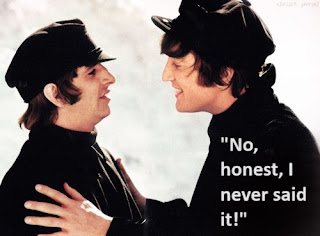 Minor historical footnote: This blogger believes that it was, in fact, his own book, Do You Want To Know A Secret?: A Fab Anthology Of Beatles Facts (Virgin Publishing, 2005 and long-since out of print) which first mentioned this comment's frequent linkage to Lennon and then suggested that this was, in fact, complete bollocks. This blogger went on to attribute the quote to Jasper Carrott simply because he happened to remember watching that particular episode on television. It was one of the - few - things this blogger is proud about in relation to that particular book, which he greatly enjoyed writing but always wished he had more time and space than he was allowed by the publisher to write something more substantial.
 Now, this blogger doesn't know whether you've noticed, dear bloggerisationism fiends, but there is a new series of From The North favourite yer actual Doctor Who due to be starting on that-there BBC (and various other places) in a couple of weeks time (11 May in the UK). It's true. It's been in the news and everything. There's been trailers released. A couple of them as it happens. And they both look geet cush and sexy as. There have also been photos released. Lots and lots and lots of them. The episode titles have been revealed. All of them. This blogger thinks it's going to be great. So no change there then.
 Mind you, a couple of days earlier, an alternative set off alleged monikers did the rounds on the Interweb which, seemingly, took one or two of the more gullible end of fandom in hook-line-and-indeed-sinker. To be fair, they had this blogger's attention ... up to The Tofu Eaters.
 Keith Telly Topping his very self did a down-the-line piece with the lovely Emma Millan and his old mate Nicky Roberts at Radio Newcastle on the subject of Doctor Who for broadcast on Emma's Easter Bank Holiday Monday show. We did about twelve to fifteen minutes in two chunks. In the first-half we talked briefly about the Christmas episode, the new series trailer, why George Harrison is playing the wrong bleedin' guitar, the return of The Moffinator, how this blogger managed to keep it a secret that he knew The Moffinator was coming back for five whole days before anyone else did (see the last bloggerisationism update) and, via that, Emma's fan-girly love of Sherlock (and, whom in all honest can blame her). Then, in the second-half, it was other TV this blogger has been enjoying recently and what we should be looking forward to later in 2024 - Mister Jones Versus The Post Office, Slow Horses and True Detective: Night Country (and one stray reference to The Sandman). Plus a bit more Doctor Who. This blogger was, as usual, a bit gobby (well, no, he was a lot gobby truth be told), but they seemed to quite like it. If you wish to check out Keith Telly Topping's latest adventures in radioland, here's the iPlayer link. This blogger is featured roughly two hours and forty four minutes in (immediately after Miley Cyrus, for those taking notes). The first part lasts about seven minutes on Doctor Who (and a bit of Sherlock) with one record in the middle - from Mimi Webb (no, me neither). Then there's a break for about twenty minutes with some bangin' tunes being played including The Verve, james and The B-52s, all of which this blogger really enjoyed cos they're his era but you can skip through those if you like, plus the 9pm news (that's definitely worth skipping through) and this blogger returns at roughly three hours nineteen minutes and thirty seconds(ish) to talk about other telly and a bit more about Doctor Who. It all finishes around the three hours thirty minutes mark. The link will be accessible until the end of April. Be there ... or be somewhere else.
 Then, on the-day-after-31-March-that-shall-not-be-named, this appeared on The Lord Th God Steven Moffat (OBE)'s Facebook page. In-keeping with the Easter theme, therefore, let this blogger boldly state he's not The Messiah, he's a very naughty boy!
 Or, to paraphrase the late, great Basil Brush. Boom and, indeed ...
 A couple of weeks ago, this blogger's good fiend Danny Blythe on his The Artist Formerly Known As Twitter page posted what he felt was a rather uncontroversial comment in praise of the fact that Doctor Who must be one of only a select handful of television series in the history of the medium which had included appearances by actors born in the Nineteenth, Twentieth and Twenty First Centuries. Which is, this blogger has to agree, quite a feat. To the surprise on many (well, certainly to the surprise of this blogger), this topic quickly became rather heated. 'To be fair, it only became "heated" because of one perplexing chap who steadfastly refused to believe that there could be actors of a venerable age still working in the 1960s,' Danny noted in the interest of accuracy when this blogger commented upon this strange happenstance on his own Facebook page the following day. 'Everyone else made some very helpful contributions,' he added. True enough. Nevertheless, this one - rather loud-mouthed - youngling, seemingly, did not believe it was feasible that a series which began in 1963 could, possibly, have featured someone born in the Nineteenth Century. That during, let's say, its first decade a handful of actors between the ages of sixty five and eighty(ish) might, possibly, have found employment on the BBC's popular long-running family SF drama series. Of course, as other contributors to Daniel's X page quickly pointed out, there were at the very least several examples of exactly that happening. This blogger himself found nine such examples between the years of 1963 and 1973 and he wasn't even looking very hard. Of course, Keith Telly Topping's fiend, the Goddamn legend that is Paul Rhodes, only went and did the job properly and discovered that there were, in fact, at least thirty actors born before 1901 who appeared in Doctor Who during the 1960s and 1970s. The full list (and thanks must go not only to Paul but also to IMDB and Wikipedia for all this) is as follows: Lionel Gadsden (born 14 Aug 1879 - meaning he was fifty seven when the BBC began television transmissions in 1936 - who played one of several uncredited Old Aztecs in The Aztecs); Frank Wheatley (born 22 Nov 1880, an uncredited Gum tribesman in one of the episodes of An Unearthly Child); Stella Wilkinson (born 14 July 1883, another uncredited Old Aztec in The Aztecs); Bert Simms (born 29 Oct 1884, the uncredited dead newspaper seller glimpsed in the opening episode of The Web Of Fear); Alice Greenwood (born 3 March 1887 yet another uncredited Old Aztec in The Aztecs); Darroll Richards (born 21 Jan 1888, who had uncredited minor roles in Small Prophet, Quick Return, War Of God and The Underwater Menace); Jack Bligh (born 29 Nov 1889, who played Gaptooth in The Smugglers); Bart Allison (born 1 Dec 1890, who appeared as Maximus Petullian in The Romans), May Warden (born 9 May 1891 and possibly the most famous person on this list, albeit her international superstardom via Dinner For One happened subsequent to her appearance as Old Sara Kingdom in the final episode of The Daleks' Masterplan); Laurence Archer (born 6 June 1892, an uncredited Priest in The Underwater Menace and a Coven member in The Daemons); Frederick Schrecker (born 10 Jan 1892, Julius Silverstein The Web Of Fear); Jeanne Doree (born 13 Dec 1893, uncredited slave in Day Of The Daleks); William Raynor (born 19 May 1893, yet another uncredited Old Aztec in The Aztecs); Rex Rashley (born 3 Oct 1894 and very well-known to long-term viewers of The Morecambe & Wise Show, who had uncredited minor roles in both Doctor Who & The Silurians and as a Coven Member in The Daemons); Gladys Spencer (born 27 Nov 1894, the voice of The High Minister in The Ark In Space); Malcolm Watson (born 1 May 1895, uncredited Council Member in The Dominators); Walter Fitzgerald (born 18 May 1896, who played Senex in The Dominators); Leslie Glenroy (born 24 Apr 1896, uncredited Meditator Planet Of The Spiders); Nelly Griffiths (born 2 Aug 1897, uncredited Prisoner in Frontier In Space); Barbara Bruce (born 26 July 1898, uncredited in Flight Through Eternity and Mollie in The Highlanders); Philip Ray (born 1 Nov 1898, Eldred in The Seeds Of Death), Juba Kennerley (born 4 May 1898, uncredited Old Man in The Sea Beggar); Frank Crawshaw (born 4 Sep 1899, Farrow in Planet Of Giants); Martin Miller (born 2 Sep 1899, Kublai Khan in Marco Polo); Jack Melford (born 5 Sep 1899, Menelaus in The Myth Makers); Charles Shaw Hesketh (born 15 Feb 1899, uncredited Coven member in The Daemons); Harold Goldblatt (born 5 Jul 1899, Professor Dale in Frontier In Space); Roy Denton (born 4 Sep 1900, uncredited minor roles in An Unearthly Child, The Invasion - as a window cleaner - and Doctor Who & The Silurians); Joan Young (born 1 Feb 1900, Catherine de Medici in The Massacre) and Sydney Arnold (born 21 Feb 1900, who was Cedric Perkins in The Highlanders). There may, as Paul rightly points out, be several more as not every actor with an IMDB page has their birth-date recorded on it. However the point is, for the benefit of the doubtful youngling who raised the question in the first place, there are indeed, more than none actors born during the Nineteenth Century who appeared in Doctor Who. Even if you ignore the uncredited ones and even if - as this blogger sometimes does - you completely forget that 1900 was still part of the Nineteenth Century not the Twentieth, there are still twelve.
 Doctor Who is not unique in featuring actors whose birth-dates cover three centuries; Coronation Street was the most obvious second example that several of us came up with and research (again, thank you Paul!) reveals that three other long-running continuous British series, Emmerdale, EastEnders and Casualty, also fall into this category. There may be others although another suggestion which looked promising, Last Of The Summer Wine, doesn't seem to have been one of them. None of us are exactly experts on US TV (certainly before the 1990s) and this blogger is aware that there were a couple of very long-running US daytime soaps which ran from the 1950s until well into the 2000s (As The World Turns and Guiding Light, for example) and there's also General Hospital which, like Doctor Who, started in 1963 and is still going; all of those may well also be examples of the three-century column). Eloise Rakic-Platt who played Ella McAvoy Forest Of The Dead, incidentally, appears to be the first credited actor born in the Twenty First Century to feature in Doctor Who.
 Billie Piper has spoken about the sadness she felt when hearing that Christopher Eccleston struggled while making their 2005 series of Doctor Who together. Speaking to the Independent, if not anyone slightly more reliable, Billie said she was unaware of how negatively Eccleston felt about the series. As, indeed, was everyone else until he started mentioning it in every interview he did.
 Billie is, of course, currently starring in the new Netflix drama series Scoop. Let's be honest, this TV movie about the Prince Andrew (he's a dirty old fucker ... allegedly)-Emily Maitlis interview-cum-fiasco-cum-comedy-masterpiece (I really shouldn't be using the word 'cum' in the same sentence as Prince Andrew, should I?) appears only to have been made because someone at Netflix Towers thought 'how can we make something that Keith Telly Topping will get really interested in? I know, we'll top-load the cast with From The North favourites Gillian Anderson, Billie Piper and Keeley Hawes. That will be good for a laugh.' Yeah, that'll work. What can this blogger say, dear blogggerisationism fiends? He's a man of simple-but-direct tastes.
 Here, meanwhile, is a recently-released Disney+ promo photo about Hulu and D+ partnering-up and getitng it on big-style and all jiggy-wid-it. Sexy. And, that's just Tom, we haven't even got to From The North favourite Kazza yet.
 Keith Telly Topping will certainly say one thing for From The North favourite, that there Neil Gaiman - when he's asked a specific question, he always gives a definitive answer.
 Which, of course, bring us to the return of When Doctors Meet It Is A Humbling Experience: Number Sixty Five. 'I'd've gone for clear ones myself ...'
 When Doctors Meet It Is A Humbling Experience: Number Sixty Six. 'Sylvester, mate, do you always have a ferret up your trouser-leg whenever there's a camera in the area?' 'Yes, David. yes, I do.'
 When Doctors Meet It Is A Humbling Experience: Number Sixty Seven. Nostalgia pornography. Take one!
 When Doctors Meet It Is A Humbling Experience: Number Sixty Eight. Nostalgia pornography. Take two!
 When Doctors Meet It Is A Humbling Experience: Number Sixty Nine. War. Huh. What is it good for?
 When Doctors Meet It Is A Humbling Experience: Number Seventy. 'Fancy a cream puff?' 'There was none of that-there gay agenda in my era, Jock!'
 When Doctors Meet It Is A Humbling Experience: Number Seventy One.'"Psst ... don't look behind you, Clara, but there's two more of them ...'
 When Doctors Meet It Is A Humbling Experience: Number Seventy Two. Take one.
 When Doctors Meet It Is A Humbling Experience: Number Seventy Three. Take two.
 When Doctors Meet It Is A Humbling Experience: Number Seventy Four. 'I have of late, but wherefore I know not, lost all my mirth.'
 When Doctors Meet It Is A Humbling Experience: Number Seventy Five. 'A little whine ...?'
 When Doctors Meet It Is A Humbling Experience: Number Seventy Six. 'Have you still got that ferret up yer trouser leg, Sylv?' 'Yes, Smudger. Yes, I have.'
 When Doctors Meet It Is A Humbling Experience: Number Seventy Seven. 'Hello Peter, I'm Peter.' 'Hello Peter, I'm Peter too.' 'Have you met Bernard?" 'Yes, everybody's met Bernard!'
 When Doctors Meet It Is A Humbling Experience: Number Seventy Eight. 'Wish I'd brought a thicker coat if I'd known it was going to be a bit chilly ...'
 When Doctors Meet It Is A Humbling Experience: Number Seventy Nine. Whatever you're doing to him, Richard, stop it, it's probably illegal.
 Next ... 'open up, it's The Pigs. Krrrsssssh.'
 'Well, that looks about it. We're sorry not to bring you The Barstard Squad, but at least we got the mad c*** with the gun, eh?'
 To literature. This little lot - freshly delivered to The Stately Telly Topping Manor by yon postie via Amazon - should, hopefully, keep yer actual Keith Telly Topping gainfully occupied over the next few weeks. He's heard really good reviews of all of them.
 Oh woe is this yer actual Keith Telly Topping, dearest bloggerisationism fiends. He recently discovered a new (and really nice) Chinese takeaway which is, quite literally, a five minute limp there-and-back from The Stately Telly Topping Manor. It's in completely the opposite direction from all of the other local shops that this blogger goes to so, hence, he wasn't even aware of its existence - apparently it's been there for about a year. It was a little more expensive than Keith Telly Topping is used to (not extortionately so but he usually get a small bit of change out of a tenner for a meal for one, this was just over - he did get change out of eleven quid, admittedly). This blogger went for an old From The North favourite, dry-fried chicken salt and chill with fried rice. And, it was, he is truly sad to report, scrumdiddlyummdiddlyummcious. With lots of emphasis on the diddly. Sad because, having just relearned how to cook for himself over the last few weeks since his previous From The North favourite, The Royal Sky, shut down, he can now see himself spending a shitload of time and money in the new gaff.
 Mind you, dear blog reader, when he was at the new Chinese takeaway, as a first time customer, this blogger was given a small token of appreciation for his service, a free fortune cookie. Nice gesture, he thought. The following morning, he cracked it open. 'Your dearest wish will come true' it claimed. Now, given that this blogger's dearest wish involves The Stately Telly Topping Manor, the Goddess-like Keira Knightley and a tin of pears in syrup, Keith Telly Topping has his doubts, personally. But you never know what the day will bring ...
 On the day after Easter, this blogger was shopping in Morrisons and noticed that Cadbury's Creme Eggs were on sale at forty pence a pop (instead of seventy five pee, as usual). And you thought this blogger was doing The Happy Dance when it was announced The Lord Thy God Steven Moffat (OBE) was returning to Doctor Who, dear bloggerisationism fiends? This blogger currently has four of the tasty little beasts in The Stately Telly Topping Manor fridge. He had five but one, ahem, disappeared.
 Looking for something completely different whilst doing some newspaper research one evening last week, this blogger stumbled across the undoubted highlight of his big brother's footballing career; from the Journal, 16 May 1972. It's not so much 'scoring the winning goal in a cup final' thing that's impressive here, it's the whole 'missing a sitter a few minutes later which would've put the matter beyond doubt' that's thigh-slappingly hilarious. Still, the furthest this blogger ever got towards The Premier League was a few scattered appearances in Walker Comprehensive's sixth-form XI (1980-82).
 When his daughter expressed how shocked - and stunned - she was at this revelation about her father's epic goalscoring feats, this blogger did have to inform Our Aly that her dad also once netted twice in a hotly-contested local derby just a few weeks earlier. Also reported in the press.
 And, speaking of football in the 1970s, dear blog reader, is this the most 'football in the 1970s' photo imaginable? The only way it could be any more 'football in the 1970s', frankly, would've been if George Best had been drinking champagne whilst naked, in bed with Miss World, in the background. Where did it all go wrong?
 In a recent From The North bloggerisationism update (specifically, this one) Keith Telly Topping was bemoaning and bewailing and be-various-other-thing-ing the lack of dear blog readers From The North has attracted in certain regions of the world; not a lot has changed since then (although we now do seem to have some visitors from Cyprus, so that's good). However, one area where From The North really does need to grow its Interweb presence footprint is in the Eastern Pacific. Therefore, it was with something approaching interest that this blogger discovered the highest ever score in an international association socherball match was when Vanuatu's Under Twenty Threes beat The Federated States Of Micronesia's Under Twenty Threes forty six-nil in the 2015 dual Pacific Games/Olympics qualifiers. And, we actually have highlights of the game. So, surely this alone is worth a couple of hits from Vanuatu (and maybe even one or two from any Micronesian masochists out there).
 This blogger can also do you Tuvalu versus New Caledonia as well. Not as many goals in that one, admittedly.
 Last Sunday yer actual was listening to Sandinista at quite obscenely bowel-shattering volume (The Stately Telly Topping Manor walls were shaking). In part, this was to drown out the hateful sounds of the bloke downstairs playing one of the only four records he possesses, Bloody Queen's Bloody Greatest Bloody Hits. But mainly it was because, like the The Man once said, 'The people must have something good to read/On a Sunday.' And when this blogger had finished with that, he moved on to Sound Affects. Again, in part, because of the deliberately punning title. But, also because, like The (other) Man said, 'oh, baby/I'm dreamin' of Monday.' This was a public service announcement. With guitars. Effing loud ones.
 It's so not fair, they wouldn't let him meet Billie Piper ...
 I bet you do, mate. Seemingly, with deep joy and furious rhythm.
 Only one entry in this week's From The North Headline Of The Week award nominations, dear blog readers. But it's a good one. Essex Live's Fed Up Essex Locals Set Up 'Pothole Parrot' In Protest Over Road Not Being Fixed. Well, that'll show them (whomsoever 'they' are). It has been nicknamed 'The Pothole Parrot of Pledgdon' readers are solemnly informed. Because it's a parrot, set up to protest about potholes. In Pledgdon, apparently. Makes complete sense when you think about it.
 Though it should be noted, in the interests of fairness, that this blogger also really wanted to include this (for the photo, if nothing else). And, in a way, he has.
 On a somewhat-related theme, let's face it, dear blog reader, if you've never seen an 'alibut snow-flaked off-its-tits on blow then, frankly, you've never lived.
 Meanwhile, here is the weather forecast for the next nine months. Sounds about right.
 Now, here is a question well-worth both asking and answering, this blogger believes. Is it because she 'doesn't like to look down on the unemployed'? Probably not, this blogger is guessing.
 Remember, if Jesus does come back any time soon - everybody, look busy. Plus, please note person who asked the question in the first place, yes this blogger is ready for 'Raputre', he thinks it's one of Blondie's best singles (he particularly likes Chris's guitar solo in the last fifty seconds).
 And finally, dear blog reader, anyone else reckon Jo Wadsworth thought about an alternative headline for her court report and then thought, 'nah, stick with yer first choice'?


